The Empire of
The Two Lights
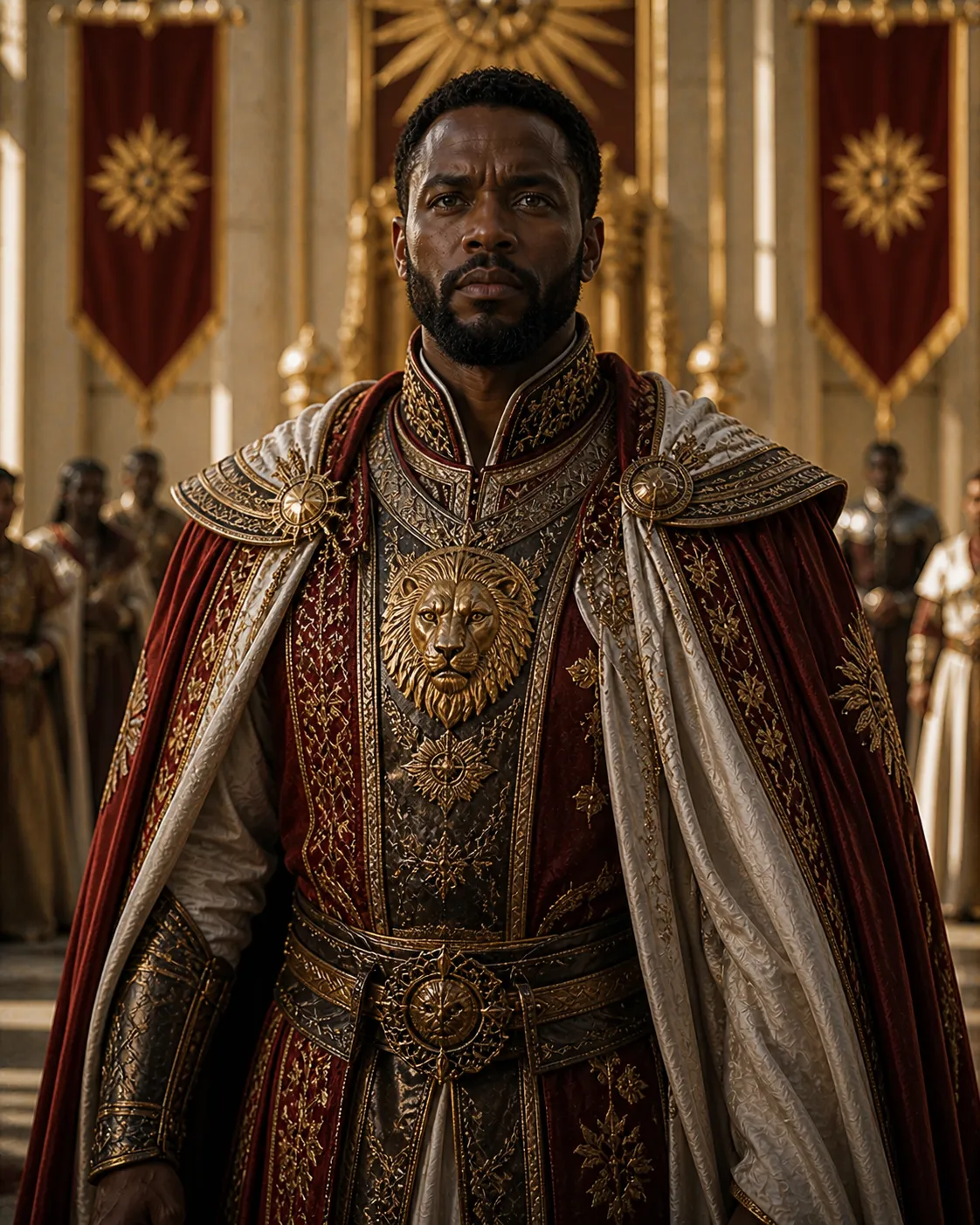
Tariq Hazzan,
Sun King
The Word of the Sun • Sovereign of the Northern Sands • Lord Protector of the Light
Overview
Tariq Hazzan, later known as Daurion, rose to become King of Hazzan under circumstances that would define both his rule and his legacy. Crowned at the age of seventeen following the death of his father in war, he inherited not only a kingdom, but an ongoing conflict that demanded immediate strength. His reign would come to be marked by conquest, devotion, and transformation—evolving from a young king into a figure his people would revere as both ruler and embodiment of divine will.
He is remembered by many titles—The Sun King, The Conquering Lion, The Virtuous King—but above all, he is remembered as the man who became “The Aurion,” a ruler whose identity was believed to be fused with the will of the Lord of the Light. His life was not defined solely by power, but by the weight of what that power demanded of him.
Biography
Birth and Lineage
Born on Vespera 8, 43 AH, in the Hazzan Kingdom, Tariq Hazzan entered a world already shaped by legacy and fracture. He was born three years after the death of his grandfather, Malik Hazzan, the founder of their house, at a time when the foundations of power were still being solidified. His early life unfolded during the Great Rift, an era defined by division and shifting authority, where his father, Kadin Hazzan, ruled Hazzan while his uncle, Idris al-Ubari, claimed the throne of Ubaris. From the beginning, Tariq’s existence was bound to a world where unity was uncertain, and power was constantly tested.
Early Life
On Solara 13, 60 AH, during the First Maurim War, Tariq’s father, King Kadin Hazzan, fell in battle after twenty years of rule. The loss was both personal and political, thrusting Tariq onto the throne at an age when most are still learning the nature of power, not wielding it. Alongside him, Musa Kalifa rose as queen, forming a union that would stand at the heart of his early reign.
His ascension was not marked by hesitation. The war with Maurim did not pause for his youth, and neither could he. From the moment he took the crown, Tariq was forced to become more than a successor—he had to become a force capable of sustaining the kingdom his father had left behind.
The Naming of Daurion
Following his coronation, Tariq experienced a divine vision from Aurion, the Lord of the Light—a moment that would redefine not only his identity, but his place within the spiritual and political fabric of the kingdom. From this vision, he was given a new name: Daurion, written as दऔरियोन, a title layered with meaning and expectation.
In the language of his people, each component of this name carries weight: “Da” signifies the word, moral responsibility, compassion, and charity; “औ” reflects brilliance and divine radiance; “रि” embodies the spark of creation; “यो” represents the breath of life and infinite movement; and “न” anchors the meaning in humanity and finality. Together, the name forms a concept rather than a title—
The Word of Divine Brilliance Ignite Into Form Expanding Movement Anchored in Reality.
Another form, दौरियोन, emphasizes duty and burden, framing his identity as one of obligation as much as divinity—
The Brilliance of Duty, the Burden of Light, the Virtue of Kingship.
This transformation was not symbolic alone. It served as a linguistic seal, marking the moment Tariq ceased to be merely a king and became something more—a living representation of Aurion’s moral law. To his people, his name was a constant reminder that power is not ownership, but responsibility.
The Architect of Legacy
On Zenith 8, 61 AH, just one year into his reign, Tariq’s firstborn son, Jalil Hazzan, was born—a moment that secured the continuation of his line. His approach to legacy was deliberate, shaping not only the future of his kingdom, but the relationships that would define it. On Hiberna 5, 63 AH, he accepted the offer of Gwarzo Qibaa to betroth his son Jalil to Noor Qibaa, binding two powerful families together from infancy.
This decision ensured that Jalil and Noor would be raised in proximity, their union not left to chance, but constructed as part of a larger vision for stability and continuity. Years later, on Primus-Aura 22, 76 AH, that vision would be realized when Jalil, at fifteen, married Noor, securing the future of the kingdom while Tariq continued his campaigns.
Rule Through War and Faith
Tariq’s reign was defined by continuous conflict, particularly his prolonged wars with the Maurim Kingdom. His leadership combined military strength with a deepening spiritual authority, as his identity as Daurion became central to how he ruled. He was not seen merely as a king issuing commands, but as a figure whose decisions carried divine weight.
In 75 AH, he appointed Ermias al-Karim as Hand of the King, ensuring that his rule was supported by capable governance even as he remained engaged in war. His ability to balance conflict and structure allowed his kingdom to endure under the constant pressure of expansion and resistance.
The Final Campaign
Despite his strength and the reverence he commanded, Tariq’s life would end as it had been defined—in war. On Primus-Aura 10, 79 AH, less than a year after the birth of his first granddaughter, Zakiya Hazzan, he fell in battle against the Maurim Kingdom.
His death marked the end of a reign forged in fire and faith, but not the end of his influence. His son Jalil would ascend the throne, carrying forward not only his crown, but the principles and identity shaped by his father.
Faith of Light
Tariq’s devotion to Aurion, the Lord of the Light, was not passive—it was defining. His vision and subsequent transformation into Daurion positioned him as both servant and embodiment of divine will. He ruled with the belief that power was not granted for personal gain, but entrusted as a moral burden.
Through Aurion, he understood kingship as responsibility—a duty to act, to protect, and to bear the weight of light without faltering.
Legacy
Tariq Hazzan did not remain only a king—he became a standard.
He lived as a ruler forged by war, transformed by faith, and remembered as something greater than either alone. His influence did not end with his death; it continued through his son, Jalil, whose rule would carry the imprint of his father’s teachings, values, and vision.
In the memory of his people, Tariq is not simply recalled as a conqueror or a king—but as the man who bore the burden of light, and chose to become it.
Profile
Biographical Information
Born: Vespera 8, 43 AH in Hazzan Kingdom
Titles
King Tariq Hazzan
The Sun King
The Word of the Sun
Sovereign of the Northern Sands
Lord Protector of the Light
The Conquering Lion
Daurion
The King Who Became the Word
दऔरियोन
The Aurion
King Daurion Hazzan
The Charity of Aurion
The Compassion of Aurion
दौरियोन
The Brilliance of Duty
The Burden of Light
The Virtuous King
Family
Parents: Kadin Hazzan (Father), Judasa Qadhafi (Mother)
Siblings: Ghafour Hazzan (Brother), Fadoul Hazzan (Brother), Tamayyurt Hazzan (Sister), Malak Hazzan (Sister), Titrit Hazzan (Sister)
Spouse: Musa Kalifa (Wife)
Children: Jalil Hazzan (Son), Bakari Hazzan (Son), Hauwa Hazzan (Daughter), Baiwa Hazzan (Daughter), Hafizu Hazzan (Son)
House / Bloodline: House Hazzan of Hazzan Kingdom, stewards of the Aurion Light; maternal blood of House Qadhafi of the holy priesthood of the Hazzan Kingdom
Affiliations
Kingdom: Hazzan
Empire Allegiance: None
Religious Alignment: Devoted to the Order of the Zenith; adherent of Aurion, the Lord of the Light
Political Alliances:
Ermias al-Karim, Small Council of the Emperor
Current Status: Alive
𖤓 NOTICE OF IMPERIAL ACCESS 𖤓
This digital codex is maintained by the Silent Scribes of the Aurionic Lyceum. All records, genealogies, and maps contained herein are the property of the Archive of Ichnusa and are preserved for the eyes of the Imperial Household and authorized scholars. By proceeding, you acknowledge the sanctity of the "Silent Truth." May Sutir guide your quill.
Direct all inquiries to the Office of the Grand Maester.
Copyright © 2026 Brilliance Entertainment. All rights reserved.