The Empire of
The Two Lights
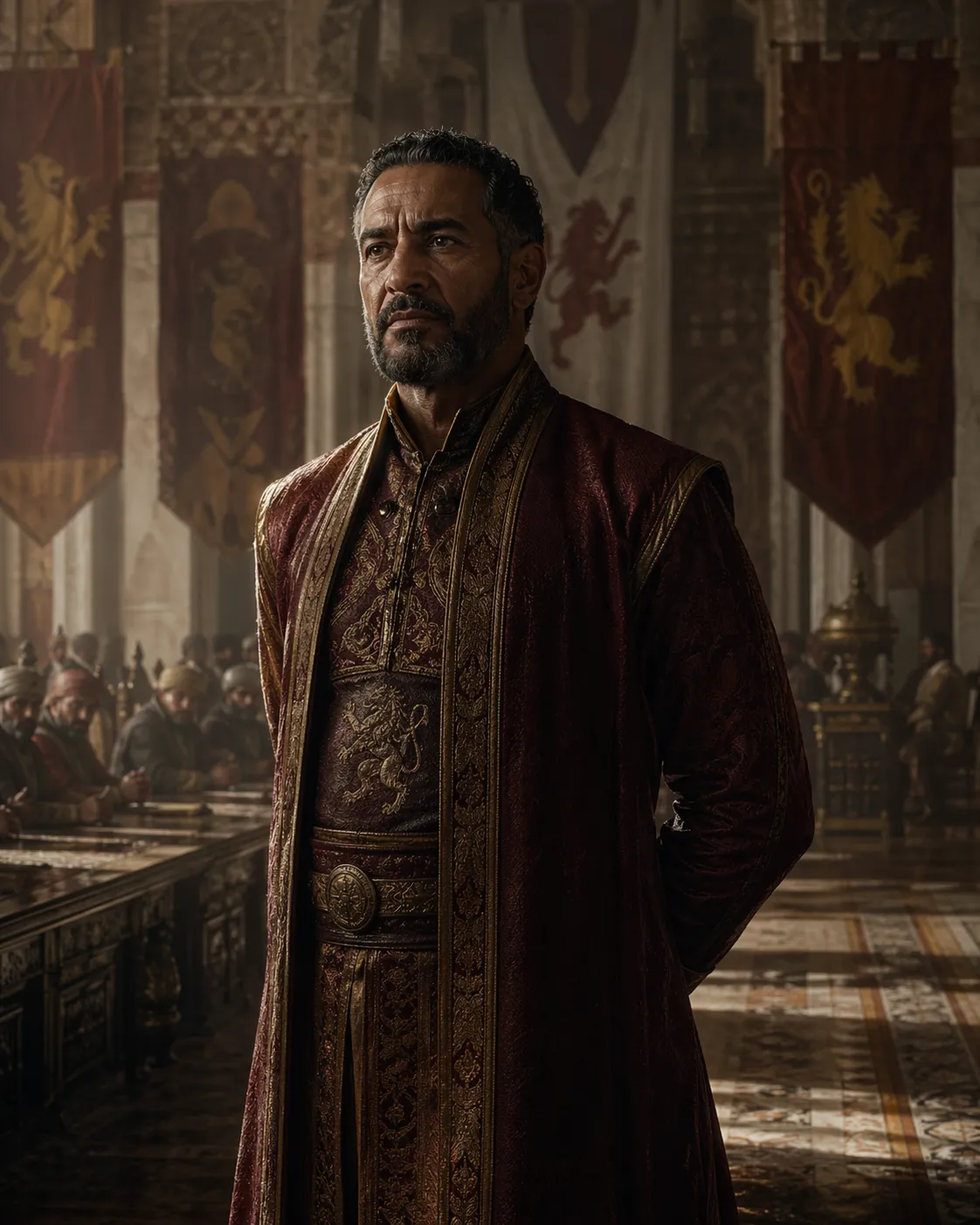
Ermias al-Karim,
Hand of the Emperor
Lord of House al-Karim • Keeper of the System
Overview
Ermias al-Karim serves as the Hand of the Emperor—second only to Jalil Hazzan in authority, and in many ways, the one who transforms imperial vision into reality.
A lifelong servant of the throne, he has governed through two reigns: first as Hand to King Tariq Hazzan, and later as Hand to Jalil, guiding the transition from kingdom to empire with precision and stability.
He is not a conqueror.
He is not a symbol.
He is the system itself.
To the court, he is law and order.
To the council, he is final authority.
To the Empire, he is the man who makes power work.
Biography
Birth and Lineage
Born on Maturis 5, 45 AH, in the Hazzan Kingdom, Ermias al-Karim stands as one of the most powerful and indispensable figures in the Aurionic Empire. Bearing the title Hand of the Emperor, he is the voice through which imperial authority is carried, the mind that shapes its governance, and the force that ensures its continuity.
Where emperors command destiny,
Ermias ensures it functions.
Early Life
Ermias was born into a family of disciplined standing within the Hazzan Kingdom, the son of Omar al-Karim and Bazzu Medina.
From an early age, he demonstrated an aptitude not for war, but for governance. While others sought glory on the battlefield, Ermias immersed himself in the study of politics, administration, and the intricate balance of power among the noble houses.
He entered the royal courts during the reign of King Tariq Hazzan, earning recognition not through spectacle, but through consistency. He understood systems—how they were built, how they failed, and how they could be controlled.
In a kingdom defined by war, Ermias became something rare:
A man who could hold the realm together when the swords were drawn elsewhere.
Rise to the Hand
In Zenith 1, 75 AH, King Tariq Hazzan appointed Ermias as Hand of the King.
It was a decision that would shape the future of the realm.
For four years, Ermias served as Tariq’s chief advisor and governing authority, managing the kingdom’s internal affairs while the king waged war. During this time, he refined the machinery of governance—ensuring that despite constant conflict, the kingdom remained stable, functional, and prepared for expansion.
When Tariq fell in 79 AH, the crown passed to his son, Jalil.
Ermias remained.
The Architect of Continuity
As Jalil Hazzan ascended to power, Ermias became the constant within a rapidly changing world.
Where Jalil envisioned an empire, Ermias made it governable.
Through conquest, alliance, and transformation, he ensured that newly acquired lands were not merely taken—but integrated. Laws were drafted, councils organized, resources allocated, and authority centralized under a single imperial structure.
When Jalil was crowned Emperor, Ermias rose with him—taking the title of Hand of the Emperor, and with it, command over the entire administrative and political apparatus of the Aurionic Empire.
The Power of the Hand
The office of the Hand is the most powerful appointed position in the Empire.
It is not ceremonial.
It is absolute.
As Hand, Ermias:
Speaks with the Emperor’s voice, his commands carrying full authority
Chairs the Small Council and directs the course of governance
Commands imperial armies in the Emperor’s absence
Drafts laws and oversees their enforcement
Sits upon the Sun Throne when required, dispensing justice in the Emperor’s name
In practice, the Hand is often the one who governs while the Emperor conquers.
And in times of uncertainty, the Hand becomes the Empire itself.
Role in the Aurionic Empire
Ermias al-Karim has been central to the Empire’s rise from a single kingdom into a unified superpower.
Working in close alignment with Empress Noor Qibaa, he has helped maintain internal stability while Jalil expanded outward. Together, they represent the backbone of imperial governance—Noor securing the loyalty of the nobility, and Ermias ensuring that the structure of power remains intact.
His influence is not bound to a single domain.
It spans:
Administration and law
Military command and logistics
Court authority and council governance
He does not compete for power.
He organizes it.
Personality and Beliefs
Ermias is pragmatic, disciplined, and unwaveringly loyal to the throne.
He does not indulge in idealism, nor does he allow sentiment to interfere with duty. To him, governance is not a matter of belief—it is a matter of execution.
He values:
Order above ambition
Stability above glory
Function above ideology
Though devoted to Aurion, his faith is expressed through structure rather than zeal. Where others see divine will, Ermias sees responsibility—the duty to ensure that what has been built does not collapse.
He is respected not because he inspires,
but because he delivers.
Legacy
Ermias al-Karim represents the unseen truth of power:
Empires are not held by crowns alone.
They are maintained by those who understand how to govern what has been won.
If Jalil Hazzan is the visionary,
and Noor Qibaa the stabilizer,
then Ermias is the executor—the force that ensures vision becomes reality and stability becomes permanence.
He does not seek the throne.
He does not need it.
For in many ways,
he already governs everything beneath it.
Profile
Biographical Information
Born: Maturis 5, 45 AH in Hazzan Kingdom
Titles
Hand of the Emperor
Hand of the King (previously)
Family
Parents: Omar al-Karim (Father), Bazzu Medina (Mother)
Siblings: None
Spouse: Fatyan Lasri (Wife)
Children: Jalid al-Karim (Son), Darras al-Karim (Son)
House / Bloodline: House al-Karim of Hazzan Kingdom; maternal blood of House Medina of the Hazzan Kingdom
Affiliations
Kingdom: Hazzan
Empire Allegiance: Aurionic Empire, Small Council of the Emperor
Religious Alignment: Devoted to the Order of the Zenith; adherent of Aurion, the Lord of the Light
Political Alliances:
Jalil Hazzan, Emperor of the Aurionic Empire
Noor Qibaa, Empress of the Aurionic Empire
Beniman Qorash, Small Council of the Emperor
Turazedek Malchior, Small Council of the Emperor
Eibhear Ó Durnan, Small Council of the Emperor
Current Status: Alive
𖤓 NOTICE OF IMPERIAL ACCESS 𖤓
This digital codex is maintained by the Silent Scribes of the Aurionic Lyceum. All records, genealogies, and maps contained herein are the property of the Archive of Ichnusa and are preserved for the eyes of the Imperial Household and authorized scholars. By proceeding, you acknowledge the sanctity of the "Silent Truth." May Sutir guide your quill.
Direct all inquiries to the Office of the Grand Maester.
Copyright © 2026 Brilliance Entertainment. All rights reserved.