The Empire of
The Two Lights
The Conclave of the Iron Bolt
“The Strike Reveals the Steel.”
Overview
The Conclave of the Iron Bolt is the faith of thunder made useful—the sacred doctrine of industry, force, and transformation that shapes the Villamvar Kingdom into the forge-heart of the wider world. Where other religions worship revelation, mercy, memory, or vigilance, the Conclave venerates a harsher and more kinetic truth: nothing of worth exists in its final form until it has been struck, tested, and remade.
This is a religion born not in courts or cloisters, but in mines, foundries, storm-towers, and mountain vaults where heat, metal, and labor are inseparable from faith. To followers of Grom, creation is not a finished miracle handed down from the heavens. It is a raw and unfinished world awaiting the hammer. Potential means little on its own. Ore buried in stone, talent left untrained, courage left untested—these are not virtues. They are wasted beginnings.
Within Villamvar, whose culture is defined by Siphoning, lightning-forged metallurgy, and an unapologetically loud ethos of strength and production, the Conclave is not merely a religion layered on top of society. It is the spiritual grammar through which society understands itself. The kingdom is already known as the roaring industrial engine of the empire, a land of storms, Thunder-Steel, and mountain forges where power is created rather than inherited.
If the Order of the Zenith is the faith of law, then the Conclave of the Iron Bolt is the faith of becoming.
Table of Contents
Core Doctrine
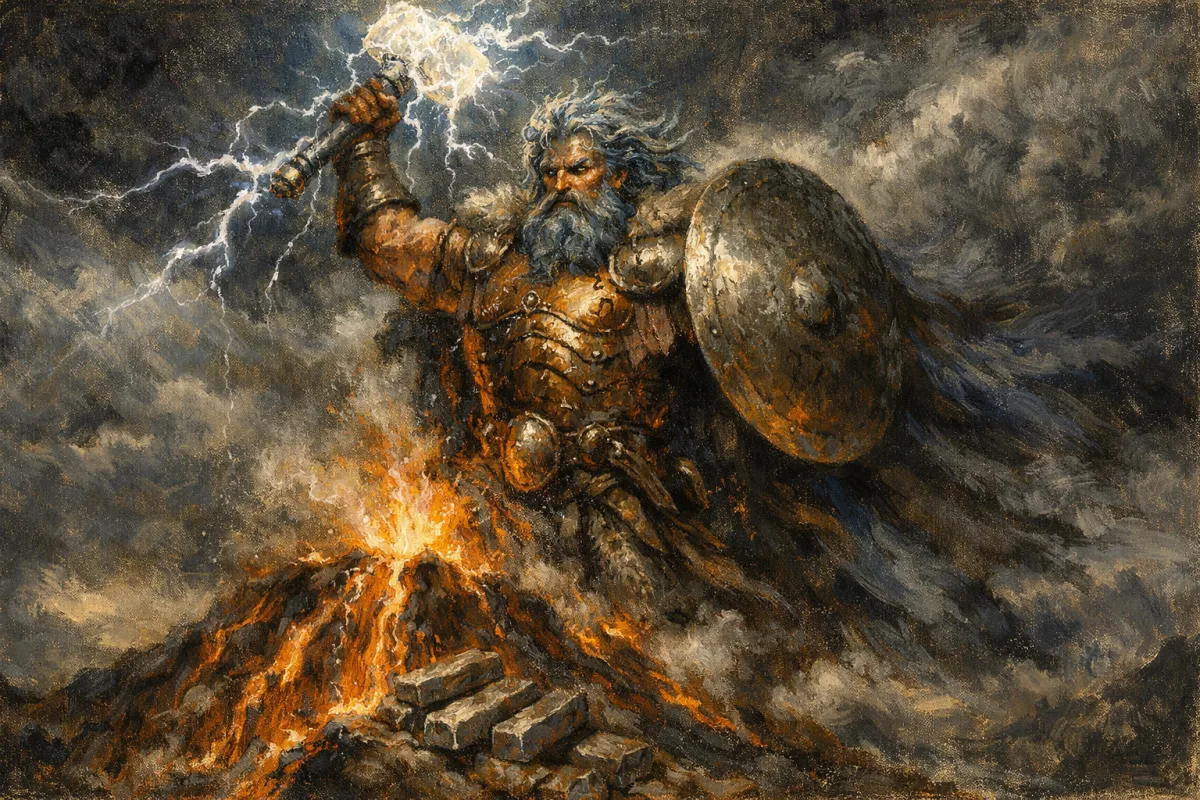
Grom, the Voice of the Strike
At the heart of the Conclave stands Grom, god of Action, Industry, and Transformation. He is known as the Voice of the Strike—the force that turns stillness into motion, raw matter into shape, and possibility into reality. To his followers, lightning is not merely a sign of divine wrath or celestial grandeur. It is the purest tool in creation: sudden, decisive, powerful, and transformative. Thunder is the sound of the cosmic forge itself, the roaring proof that the world is still being worked.
Unlike gentler gods who comfort or illuminate, Grom demands exertion. He is not interested in contemplation for its own sake, nor in the passive admiration of greatness. He is the patron of motion, productivity, invention, and force applied with purpose. In the theology of the Conclave, a thing proves itself not by what it claims to be, but by what it survives.
This gives the faith a distinctly practical and martial character. To worship Grom is to believe that the world improves only through pressure. Metal becomes useful beneath the hammer. Stone becomes a fortress when cut. A person becomes worthy when tested.
The Blue Fire of Creation
The Conclave teaches that when Aurion first struck the primordial stone, the impact did not only create light. The friction of that unimaginable blow created a deafening crack and a blinding flash. That force—that first explosive act of energy—was Grom. While Aurion’s light remained in the heavens, Grom descended into the mountains as a bolt of blue fire, shattering stone and exposing the hidden veins of iron and bronze beneath.
In this telling, Grom is the divine force that reveals the world’s hidden usefulness. He does not create beauty by covering or softening. He creates it by breaking surfaces open until what lies within can be shaped. He taught the first men that the world is not to be accepted in its raw condition. It must be worked. Hammered. Refined.
This myth reveals the central imagination of Villamvar’s faith: the mountain is not merely landscape, but a vault of sleeping potential. Lightning is not destruction, but awakening. Creation itself was not a quiet unfolding. It was a strike.
The Law of the Strike
The highest tenet of the religion is the Law of the Strike:
“Strength is not found, it is forged.”
This doctrine forms the core of Villamvar ethics. To a follower of Grom, stagnation is the great enemy—not weakness alone, but refusal to improve. A blade left dull, a forge left cold, a skill left undeveloped, a wall left unreinforced, a mind left idle: all are violations of divine purpose. The faithful are expected always to be doing something that sharpens, strengthens, or transforms.
The Law of the Strike also rejects the idea that worth is innate or effortless. Strength must be earned through heat, impact, and endurance. This applies equally to steel, cities, armies, and souls. A person without trials is unproven metal. A kingdom without production is empty thunder.
In this faith, progress is not optional. It is sacred duty.
The Broken Bolt (above)
Blessed of Grom
Marko Villam, King of Villamvar
Dragan Villam, King of Villamvar
Viktoras Villam, King of Villamvar
Branko Villam, Prince of Villamvar
Iskra Villam, Prism of Villamvar
Leaders of the Conclave
Radu Kreanga, Forge-Master
Dimitry Anghelescu, Forge-Master
Horea Blerinca, Forge-Master
Seats of Worship
Villamvar Kingdom
Current Status: Alive
Table of Contents
Rites & Rituals
The Day of the First Spark
The holiest observance of the Conclave is the Day of the First Spark, held on the 10th day of Fulmen, the month of storms in the Aurionic calendar. Fulmen is the sixth month of the year, associated throughout the empire with thunder, late-summer tempests, and the distinct power of Villamvar.
On this day, the Great Forges of Villamvar are driven to their highest possible heat. Apprentices, especially the youngest among them, undergo a ritual of initiation in which they must catch a “wild spark” leaping from the master’s anvil and use it to ignite their own hearth for the coming year.
The symbolism is unmistakable. Skill is not bestowed gently; it must be seized from danger. The apprentice does not inherit fire in comfort. They prove themselves worthy to carry it. The ritual also reinforces a core Villamvar value: every household, forge, and worker must maintain their own source of productive heat. Fire is not only life. It is obligation.
The Tempering Oath
The sacred vow of the Conclave is the Tempering Oath, sworn by warriors, smiths, laborers, and all who would align themselves with Grom’s doctrine. It is a promise to endure hardship without breaking and to remain true under the hammer of fate.
This oath expresses the religion’s deeper anthropology. Human beings are not admired for fragility preserved from all strain. They are admired for resilience created through strain. To be tempered is not merely to survive pain, but to be improved by it.
Because of this, the oath has force far beyond ritual. It shapes ideals of masculinity, labor, rulership, military conduct, apprenticeship, and communal pride. A Villamvar follower does not merely hope to avoid suffering. They expect it, and expect themselves to become harder within it.
The Molten Return
The funerary rite of the faith is known as the Molten Return. Honored dead are placed in bronze sarcophagi and lowered into volcanic vents or the highest-heat furnaces in the mountains. Their bodies are consumed by what the faithful call the Blood of the Earth, returning their strength to the very foundations of the kingdom.
This is one of the most revealing practices of the Conclave. Death is not framed as ascent into serenity or dissolution into mist. It is reintegration through heat. The dead do not leave the kingdom behind; they are given back to the engines that sustain it. In a land built on mining, forging, and volcanic force, this rite makes the mountains themselves into tomb, altar, and crucible.
The dead are therefore remembered not as absent, but as having become part of the kingdom’s continuing strength.
Table of Contents
Symbols & Sacred Iconography
The Broken Bolt
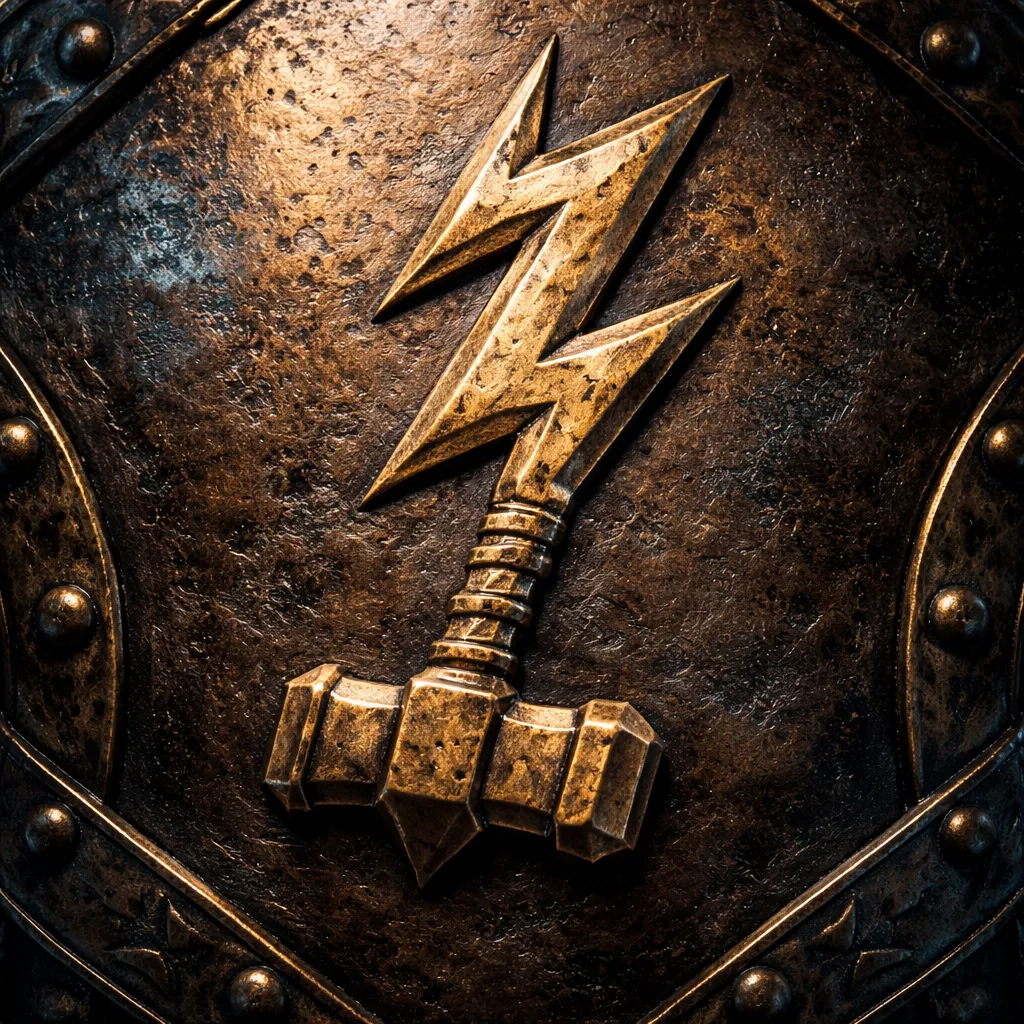
The holy mark of the Conclave is the Broken Bolt: a jagged, Z-shaped lightning bolt ending in a heavy flat-headed hammer. It symbolizes the union of celestial energy and physical labor—the moment where divine force becomes mortal industry.
Its structure is important. The bolt alone would signify raw power. The hammer alone would signify craft. Joined together, they proclaim the religion’s most central idea: power is sacred only when shaped into work.
Vestments of Forge and Storm
Priests of the Conclave wear Polished Bronze aprons over tunics of Electric Blue and Slate Gray, colors that mirror metal, lightning, and storm-cloud. Their arms are often left bare to reveal the so-called Tempering Scars earned in the forge, which function as both marks of endurance and signs of religious legitimacy.
This vestment tradition reflects a significant difference between the Conclave and more courtly religions. Its priests are not meant to appear untouched, immaculate, or above labor. Their bodies themselves bear the signs of work. Scars are not disfigurements. They are credentials.
The Storm-Anvil
Among the most revered sacred objects of the faith is the Storm-Anvil, an ancient block of star-iron kept in the Heart of Villamvar. It is said that when struck during a thunderstorm, it vibrates with a force capable of shattering the stone of enemy walls.
Whether mythologized or literal, the Storm-Anvil represents the theological union of heaven and industry. Lightning descends. Iron answers. From that marriage comes power sufficient to alter history. It is not difficult to see why this relic would occupy such a central place in a kingdom whose identity is built on storm-forged supremacy.
The Iron Bull (above)
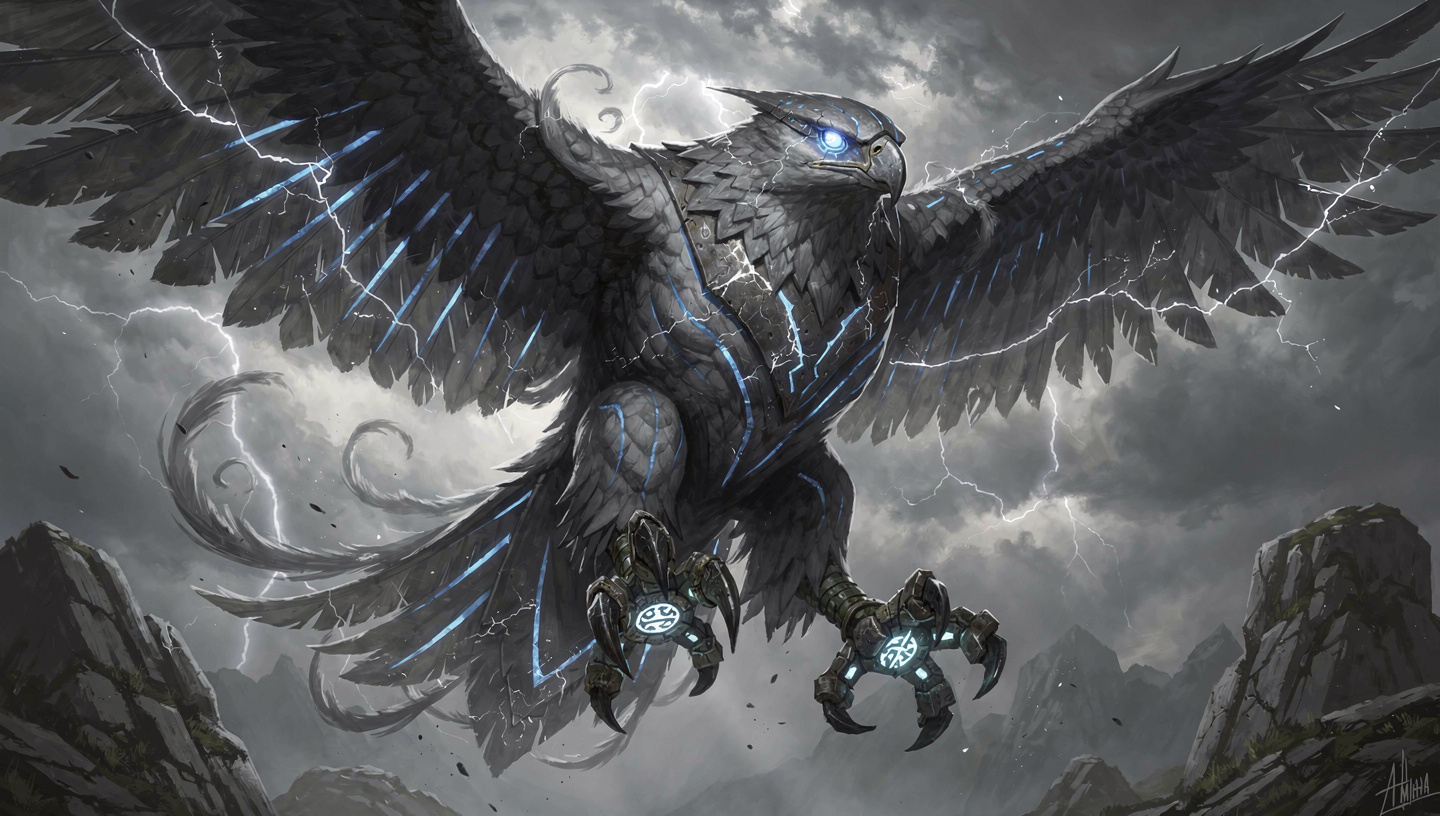
The Great Thunderbird (above)
Sacred Beasts
The Conclave’s iconography features two sacred beasts:
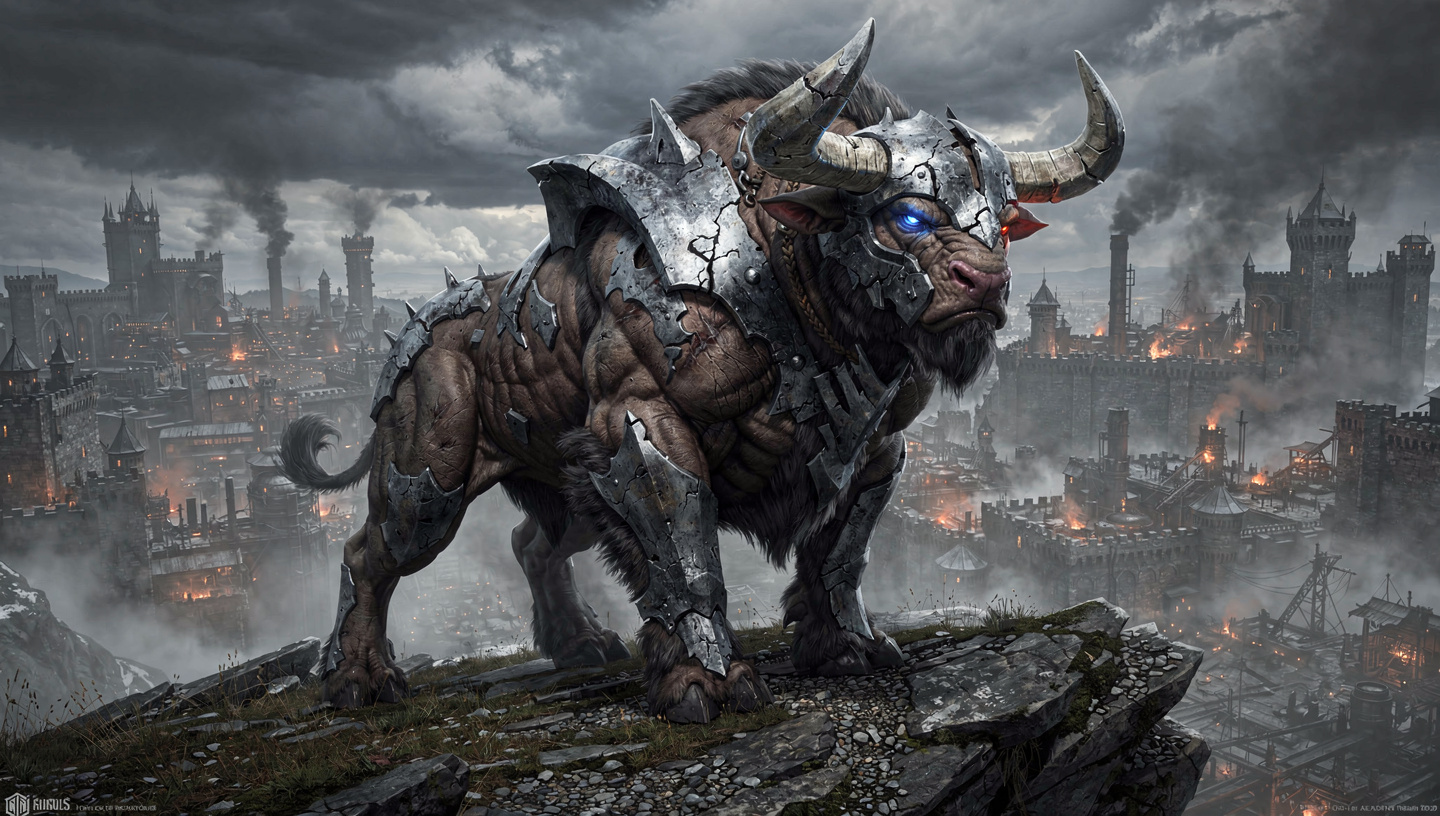
The Iron Bull — labor, endurance, mass, and brute productive force
The Thunderbird — exalted storm-power, divine velocity, and the untamed majesty of Grom’s favor
The Bull grounds the religion in toil and strength. The Thunderbird elevates it into mythic force. Together, they capture the double nature of Villamvar’s faith: deeply physical, yet never merely mundane.
Table of Contents
The Priesthood & Cultural Influence
The Iron-Thanes
The faith is governed by the Iron-Thanes, a council composed of master smiths and the greatest architects of the kingdom. Their leadership structure reflects the values of the faith with unusual clarity: authority belongs not to secluded mystics or hereditary priests, but to those who have demonstrated mastery over materials, construction, and productive force.
At the head of this system stands the Forge-Master, high priest of the Conclave and overseer of both the kingdom’s spiritual welfare and its industrial output. This dual role is crucial. In Villamvar, production is not secular while worship is sacred. Production is sacred. The health of the kingdom’s forges, workshops, weapons, and great works is itself a measure of religious vitality.
This makes the Conclave one of the most materially integrated religions in the world. It does not bless industry from afar. It governs through it.
Centers of Worship
The principal holy sites of the Conclave are the Great Vaults of Villamvar and the Storm-Spires—high bronze towers built atop mountain peaks to attract lightning, which is then channeled into the lower forges.
These spaces are magnificent not because they are delicate, but because they are functional on a mythic scale. A Storm-Spire is both temple and machine. A Great Vault is both sanctuary and industrial heart. Worship in Villamvar is inseparable from engineering. The kingdom does not merely admire storms. It captures them.
The Rust-Sin
The great taboo of the faith is Stagnation, called the Rust-Sin. Allowing a tool to go dull, a forge to cool without cause, or a mind to grow lazy is considered an offense against Grom’s very nature.
This taboo reveals the Conclave’s underlying cosmology. The world is always in motion, always under shaping force. To stagnate is to resist creation itself. Rust becomes more than physical decay—it is the image of neglected potential, of strength surrendered without struggle.
In a practical sense, this taboo helps explain the relentless drive of Villamvar culture. Maintenance is holy. Innovation is holy. Sharpening, repairing, and reworking are holy. A civilization formed under this creed will always be noisy, ambitious, and slightly intolerant of passivity.
View of Other Faiths
The Conclave regards the Order of the Zenith as the Source—acknowledging Aurion’s primal role in first light and first force—but often criticizing the Hazzan tendency toward proclamation over production. In their view, the northern orthodox speak grandly of power while relying on others to shape it into steel, towers, and engines.
The followers of Foraoise, by contrast, are viewed as Unworked Ore—full of latent possibility, but stubbornly unwilling to submit to the shaping force necessary to become useful. This judgment is deeply revealing. The Conclave has difficulty respecting potential left in its natural state. To Villamvar’s faithful, value must be activated through pressure, labor, and heat.
As with much else in the religion, other beliefs are measured according to whether they are productive, durable, and fit for use.
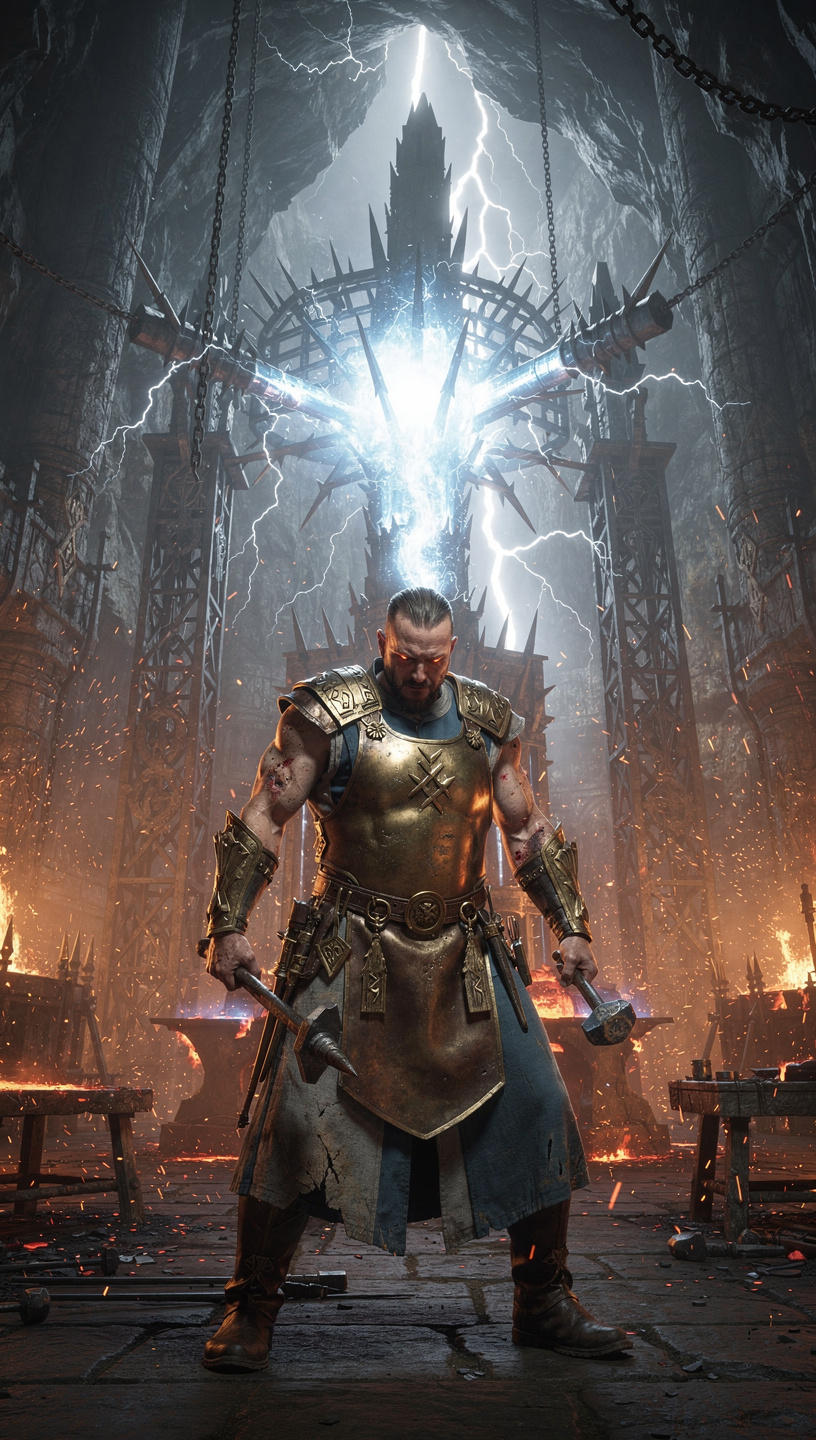
Priest Robes (above)
Table of Contents
Omens & Prophecy
The Hammer’s Fall
The Conclave interprets the births of 85 AH as The Hammer’s Fall. To them, these girls are not simply strange or holy children, but the final decisive blows in a process long underway. They may be the strikes that complete the armor of the empire—or the ones that crack the anvil beneath it.
This is a strikingly Villamvar way of understanding prophecy. The future is imagined not as a story unfolding gently, but as a workpiece on the edge of completion or catastrophic fracture. The same force that perfects a thing can also destroy it if applied at the wrong moment or with the wrong angle.
Thus prophecy, in this faith, is less about passive foretelling than about stress-testing the world.
The Silent Forge
The darkest prophecy of the religion is the Silent Forge: a day when the mountains of Villamvar go cold and the sky refuses to spark. When this happens, the world will have become brittle, deadened, and ready to be broken by the darkness of the Void.
The terror of this prophecy lies in what it removes. If Grom is the force that keeps reality dynamic, workable, and strong, then a silent forge means the end of transformation itself. No heat. No strike. No remaking. Only brittle stillness awaiting fracture.
It is, in effect, an apocalypse of uselessness. Not only death, but the end of the world’s capacity to become anything better than it is.
Legacy
The Conclave of the Iron Bolt stands as one of the most forceful and materially grounded religions in the known world. It sanctifies labor, glorifies endurance, and teaches that every worthy thing must survive pressure before it earns its final shape. It is not a faith of passivity, and certainly not one of delicacy. It is a religion of sparks, anvils, mountain heat, and the unashamed belief that civilization must be made by human hands under divine storm.
To outsiders, it can seem abrasive.
To courtiers, it can seem crude.
To gentler priesthoods, it can seem dangerously enamored with force.
But in a world of walls, wars, engines, and empire, few can deny its truth:
the realms that endure are the ones that can still build.
It is the hammer lifted in the storm.
The bronze tower drinking lightning from the sky.
The scarred hand that shapes raw power into something the world can wield.
For the faithful of Grom do not wait for destiny to arrive fully formed.
They forge it.
𖤓 NOTICE OF IMPERIAL ACCESS 𖤓
This digital codex is maintained by the Silent Scribes of the Aurionic Lyceum. All records, genealogies, and maps contained herein are the property of the Archive of Ichnusa and are preserved for the eyes of the Imperial Household and authorized scholars. By proceeding, you acknowledge the sanctity of the "Silent Truth." May Sutir guide your quill.
Direct all inquiries to the Office of the Grand Maester.
Copyright © 2026 Brilliance Entertainment. All rights reserved.