The Empire of
The Two Lights

Auroreline Kingdom
“first to the Dawn”
Overview
The Auroreline Kingdom is the cultural jewel of the eastern world—a realm of refinement, beauty, and sacred philosophy where the rising sun is not merely seen, but revered as divine promise. Born from vision rather than conquest, Auroreline embodies the harmony between Aurion’s Light and Aurah’s Dawn, balancing strength with grace and intellect with artistry.
Its sigil, the Horse, reflects both elegance and power, symbolizing a kingdom whose cavalry and culture alike have shaped the course of history. Known for its glass palaces, poetic traditions, and radiant coastal cities, Auroreline has long stood as both rival and counterpart to harsher kingdoms like Nottgard. Yet beneath its beauty lies a history of war, resilience, and ultimately, reluctant submission to a greater empire.
Table of Contents
History
The Great Illuminance and the Birth of a Kingdom
Before its unification, Auroreline was a fractured land of warring duchies, each vying for control of fertile lands and coastal wealth. This era of division ended not through conquest, but through revelation. Vivienne “The Dawn-Eyed” Beauregard, a mystic of profound influence, claimed to have witnessed a vision of Aurah standing upon the northern cliffs, calling the land to unity beneath the beauty of the Dawn.
On Primus-Aura 1, 110 BH, she united the duchies through the movement known as the Great Illuminance, a cultural and religious awakening that elevated harmony, artistry, and spiritual devotion above warfare.
Under Vivienne’s guidance, Auroreline became a kingdom defined by its aesthetic and philosophical identity. She founded Aube-sur-Mer, a radiant coastal capital, and constructed the Palais de l’Aurore, a palace of glass and light that embodied the celestial elegance of her vision. Her reign established the enduring duality of Auroreline’s faith—honoring both Aurion and Aurah—and laid the foundation for a society that prized beauty, intellect, and refinement as expressions of divine order.
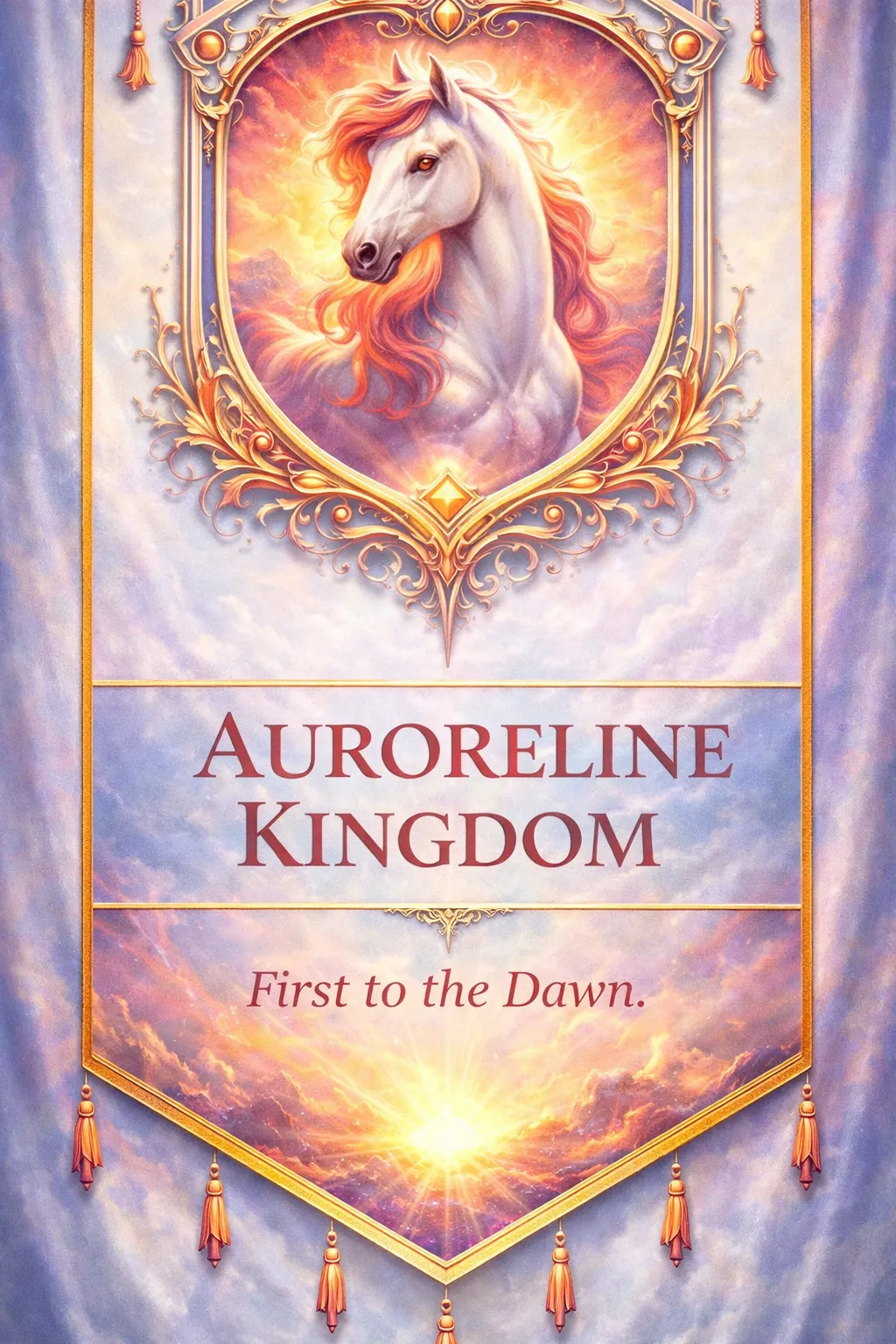
Kingdom Details
Sigil: Horse
Patron Deity: Aurion, the Lord of the Light, and Aurah, the Lady of the Dawn
Religion: The Order of the Zenith, and the Order of the First Ray
Colors:
Soft blues
Fiery coral-reds
Purples
Whites
Pledged Houses
House Beauregard
The Archive of Ichnusa
Current Status: Active
Table of Contents
The Centuries of Iron and Silk
The history of Auroreline is inseparable from its enduring rivalry with the Nottgard Kingdom, a conflict that came to define both nations. On Fulmen 22, 54 BH, tensions over fertile river valleys erupted into what would become known as the Centuries of Iron and Silk—a prolonged struggle between Auroreline’s elegance and Nottgard’s brutality. Where Auroreline wielded cavalry, strategy, and culture, Nottgard responded with iron, endurance, and siegecraft.
Under King Louis III “The Sun-King” Beauregard, who ascended the throne shortly after Vivienne’s passing, Auroreline entered a period of both war and prosperity. The War of Silver Lilies and subsequent conflicts saw Auroreline’s knights dominate the battlefield through superior cavalry tactics, humiliating Nottgard’s infantry and fueling a grudge that would last generations. Even as war raged, Louis expanded the kingdom’s influence through the Silk Trade Expansion, ensuring that Auroreline remained not only a military power, but a cultural and economic one.
Yet this era also gave rise to the Century of Spite, a hundred years of relentless skirmishes that drained both kingdoms, locking them in a cycle of rivalry neither could escape.
The Twilight of Independence
The later years of Auroreline were marked by resilience in the face of mounting pressure. Under Queen Marcella “The Golden Quill” Beauregard, the kingdom strengthened its intellectual and cultural foundations, forging a partnership with the Archive of Ichnusa on Aestiva 6, 2 BH. This alliance elevated Auroreline as a center of learning, allowing Maesters to educate its nobility while its scholars gained access to the vast knowledge of the Archive. Yet even in this era of enlightenment, the threat of Nottgard remained ever-present.
On Maturis 21, 6 AH, during the Siege of the Night, Nottgard attempted to extinguish the “Light of the Dawn” by besieging Aube-sur-Mer during a brutal winter. Auroreline survived only through its wealth, hiring mercenaries from the Maurim fleets to break the siege. This victory, however, foreshadowed a deeper truth: Auroreline’s strength alone could no longer guarantee its survival. When Emperor Jalil Hazzan marched upon its lands on Zenith 14, 82 AH, he first arrived as a savior—repelling Nottgard forces—before revealing his true intent. To spare his people from destruction, King Charles “The Defiant” Beauregard surrendered his crown and his daughter, Juliette, binding Auroreline to the Aurionic Empire not through annihilation, but through sacrifice.
𖤓 NOTICE OF IMPERIAL ACCESS 𖤓
This digital codex is maintained by the Silent Scribes of the Aurionic Lyceum. All records, genealogies, and maps contained herein are the property of the Archive of Ichnusa and are preserved for the eyes of the Imperial Household and authorized scholars. By proceeding, you acknowledge the sanctity of the "Silent Truth." May Sutir guide your quill.
Direct all inquiries to the Office of the Grand Maester.
Copyright © 2026 Brilliance Entertainment. All rights reserved.