The Empire of
The Two Lights

The Vigil of the Obsidian Crown
“The Watch is Eternal; the Dark is Patient.”
Overview
The Vigil of the Obsidian Crown is the faith of endurance at the edge of annihilation—a severe, stoic religious order built not on triumph, but on survival. Where the great solar doctrines of the south speak of enlightenment, revelation, and sacred destiny, the Vigil concerns itself with a far simpler and harsher truth: someone must stand watch when the light fails.
Rooted in the frozen culture of Nottgard and bound to the unyielding duty of the Wall, the Vigil is less a religion of comfort than a religion of readiness. Its followers do not expect warmth from their god. They do not seek visions of paradise or promises of glory. They seek only the strength to endure one more night, one more winter, one more assault from the things that wait beyond the boundaries of the civilized world.
To outsiders, the Vigil can appear grim, joyless, even inhuman in its severity. But to those who live beneath its discipline, it is the faith that makes survival possible. It is the creed of those who understand that civilization is not preserved by splendor, but by those willing to freeze in silence so others may sleep in safety. Within the greater Aurionic world, Nottgard is remembered as the southern bulwark against the horrors beyond the Wall, a kingdom defined by endurance, necessity, and the belief that if it falls, all else falls after it.
If the Order of the Zenith is the faith of divine law, then the Vigil of the Obsidian Crown is the faith of last defense.
Table of Contents
Core Doctrine
The Silent God of the Boundary
The Vigil venerates Vetr, god of Endurance, Vigilance, and Necessary Silence. He is not imagined as a radiant king, a merciful mediator, or a giver of abundance. He is the sentinel at the threshold—the being who stands between the ordered world and the devouring void beyond it. To the people of the Vigil, Vetr does not crave devotion in the way warmer gods do. He demands no flattery. He offers no softness. He asks only this: be ready.
In Vetr, night is not evil. Darkness is not automatically corruption. The Vigil makes a distinction central to its worldview: there is the Safe Dark, the sacred night of concealment, patience, and disciplined watchfulness; and there is the Deep Dark, the devouring abyss associated with Vefna and the things that move beyond the known edges of the world. Vetr governs the first so that mortals may survive the second.
This is one of the defining theological differences between the Vigil and the southern faiths. Where the solar orders often imagine darkness as ignorance or heresy, the followers of Vetr understand that some darkness is necessary. Some darkness shelters. Some darkness sharpens the senses. Some darkness is the cloak beneath which civilization survives.
The Obsidian Shard of Creation
The Vigil’s creation myth is not told in the triumphant language of first light conquering formless chaos. It is told as a memory of crisis.
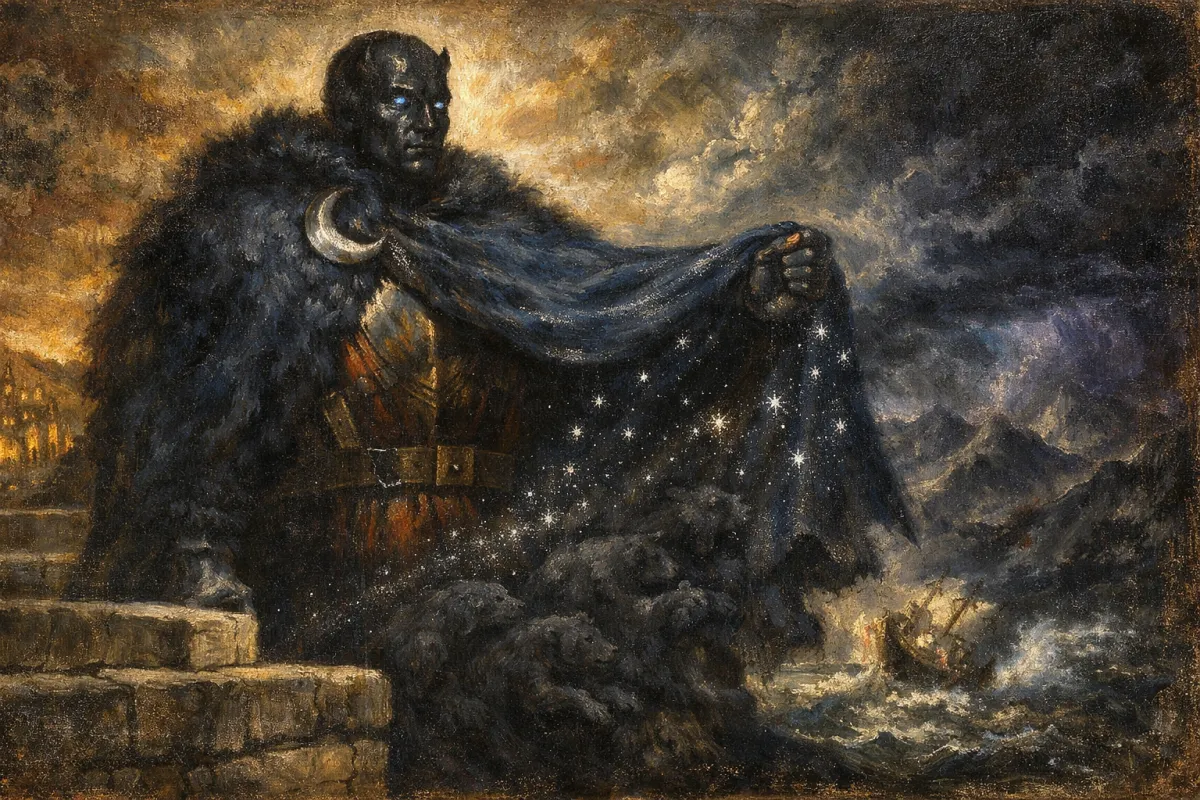
When Aurion first struck the primordial stone and scattered the first lights across creation, one shard flew far beyond the warmth of dawn and the authority of the sun. That shard was a cold splinter of obsidian, cast into the furthest reaches of the heavens. That shard became Vetr. Seeing the Sjónlauss, the Sightless Void, stretching itself hungrily toward the newborn world, Vetr stood at the outer edge of being and unrolled his vast midnight cloak. Into that cloak fell the stars, caught and preserved so that those who traveled in darkness would not be wholly blind.
In this tradition, Vetr is not the enemy of light. He is its guardian at the boundary. He catches what would otherwise be lost. He holds the line between visibility and oblivion. As fear of Vefna retreated into hushed warning and taboo, Vetr came to embody the Night itself—not the abyssal void, but the disciplined, watchful dark that keeps the abyss at bay.
Thus the Vigil teaches that night is not merely a natural cycle. It is an act of guardianship.
The Law of the Bastion
The highest principle of the faith is the Law of the Bastion:
“Stand where the light fails.”
This tenet defines not only theology, but identity. A true follower of Vetr is not measured by eloquence, purity, or even piety in the southern sense. They are measured by whether they remain at their post when others retreat. The greatest virtue is to become a wall—to absorb terror without yielding, to endure cold without complaint, and to stand firm where lesser souls would flee.
In the philosophy of the Vigil, courage is not recklessness and faith is not spectacle. Faith is steadiness. Faith is silence under pressure. Faith is holding a torch with a numb hand and refusing to let it fall.
This worldview shapes every institution touched by the religion. The Wall is not simply a military fortification. It is a theological object. The guard-post is not merely a duty station. It is a sacred threshold. To endure at the boundary is to imitate Vetr himself.
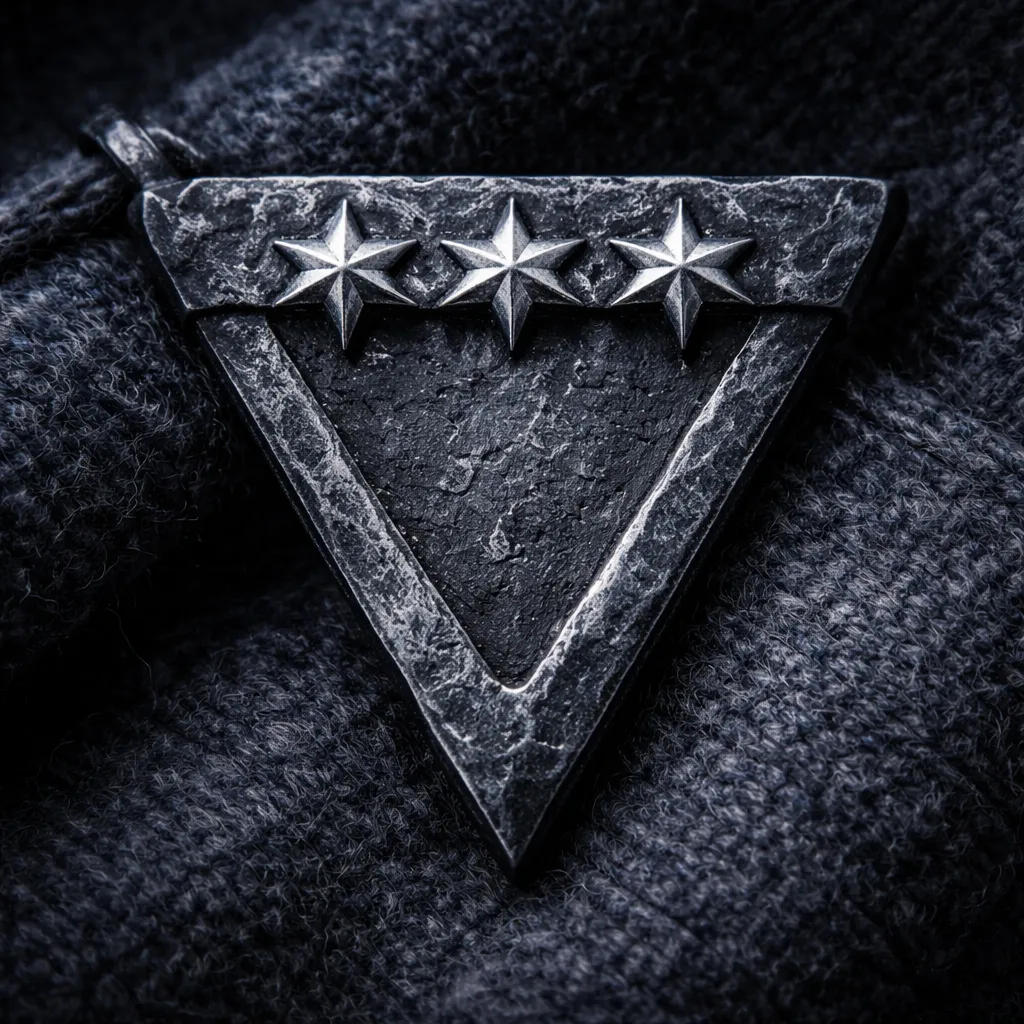
The Silver Mantle (above)
Blessed of Vetr
Lothar von Nottgard, King of Nottgard
Gunther von Nottgard, King of Nottgard
Sigrid von Nottgard, Queen of Nottgard
Erik von Nottgard, King of Nottgard
Ragnar von Nottgard, King of Nottgard
Alaric von Nottgard, King of Nottgard
Joran von Nottgard, Prince of Nottgard
Nyx von Nottgard, Priestess
Leaders of the Vigil
Ingirun, Iron Spákona
Alfids, Iron Spákona
Isgerd, Iron Spákona
Fastvi, Iron Spákona
Odindis Steinkeldottir, Iron Spákona
Thorunn Hakidottir, Iron Spákona
Seats of Worship
Nottgard Kingdom
Current Status: Alive
Table of Contents
Rites & Rituals
Vetr-Nótt, the Longest Night
The holiest observance of the Vigil is Vetr-Nótt, the Longest Night, kept on the 28th day of Hiberna, the winter solstice in the Aurionic calendar. Hiberna is the twelfth month of the year, the deep winter period remembered as the Silent Month of the Maesters, just before the final chill of Vetr-Mon.
On this night, all hearth fires in Nottgard are extinguished for one full hour. No flame is permitted. No comforting glow is allowed to break the dark. The people stand in absolute silence, enduring cold and blackness as a test of spirit and discipline. This ritual is not symbolic theater. It is a reenactment of the primal truth of the faith: civilization survives only when human beings can face darkness without surrendering to panic.
When the hour passes, the fires are rekindled using Vetr-Silver flints, an act that signifies not conquest over night, but perseverance through it. The lesson is clear: the dark will come, and it will come again. Holiness lies not in banishing it forever, but in proving that one can remain whole within it.
The Oath of the Obsidian Gate
Among the most sacred vows in the Vigil is the Oath of the Obsidian Gate, sworn by every member of the Veggdrótt, the Wall-Guard. It is a blood-oath of extreme severity: never to turn one’s back on the South, never to abandon the threshold, and to die before allowing a single shadow-creature to cross into the world of men.
This oath reveals the true character of the Vigil. It is not devotional in the poetic or celebratory sense. It is contractual, martial, and absolute. To swear it is to surrender any claim to ordinary life. One becomes, in effect, part of the Wall—not an individual soul seeking personal salvation, but a living stone in a structure that must not fail.
The oath also reflects Nottgard’s larger role in the world. The kingdom sees itself as the shield behind which softer lands survive, the silent defender upon whom the rest of civilization depends. That mentality—grim, proud, and stripped of illusion—saturates the Vigil at every level.
The Frozen Vigil
The funerary rites of the order are among the most severe and haunting in the known world. In the rite called the Frozen Vigil, the dead are not burned, buried in earth, or committed to open sky. They are interred directly within the ice and stone of the Southern Wall itself. Their names are carved into obsidian blocks, making the fortification a literal monument of the dead who once guarded it.
This ritual expresses one of the faith’s deepest beliefs: duty does not end with death. The ancestors remain part of the defense. Their bodies strengthen the Wall physically; their names strengthen it spiritually. In this way, the Vigil transforms remembrance into infrastructure. The dead are not merely honored. They are incorporated.
The result is a theology of immense emotional force. To walk the Wall is to walk among the dead who never abandoned their post. To defend it is to stand beside generations of watchers whose vigilance did not end when their hearts did.
Table of Contents
Symbols & Sacred Iconography
The Silver Mantle
The chief holy mark of the Vigil is the Silver Mantle: an inverted iron triangle crowned with three reflective stars of Nottgard silver. The downward point evokes descent, weight, and anchoring force—everything the faith values in opposition to drift, softness, or false transcendence. The stars above it symbolize guidance in darkness, the lights caught and preserved within Vetr’s cloak.
It is a stark and functional emblem, entirely in keeping with the order’s aesthetic. Unlike the blazing halos and jeweled crescents of southern traditions, the Silver Mantle does not invite awe through beauty. It commands respect through severity.
Colors of the Guarded Night
Priests and guardians of the Vigil wear Midnight Blue, Slate Gray, and Frost-Silver, often layered beneath heavy furs of black bear or wolf. These garments are practical, but never merely practical. They signal the identity of the wearer as one who belongs to the night not as prey, but as hunter.
The darkness of their clothing does not symbolize corruption. It symbolizes acclimation. To follow Vetr is to become comfortable in the conditions that terrify others. The furs in particular reinforce the image of the faithful as Predators of the Dark—those who hunt what hunts humanity.
The Obsidian Crown
At the center of the religion’s sacred imagination stands the Obsidian Crown, a jagged circlet of volcanic glass kept in the hidden depths of Nottgard. It is said to grant the High Spákona the power to see through the eyes of ravens and wolves all along the Wall, turning the wilderness itself into an extension of sacred vigilance.
Whether taken literally or as pious tradition, the significance is the same: true rulership in Nottgard is inseparable from sight, watchfulness, and the ability to sense danger before it breaches the threshold. The crown is not an ornament of glory. It is an instrument of perception.

Frost Bear (above)
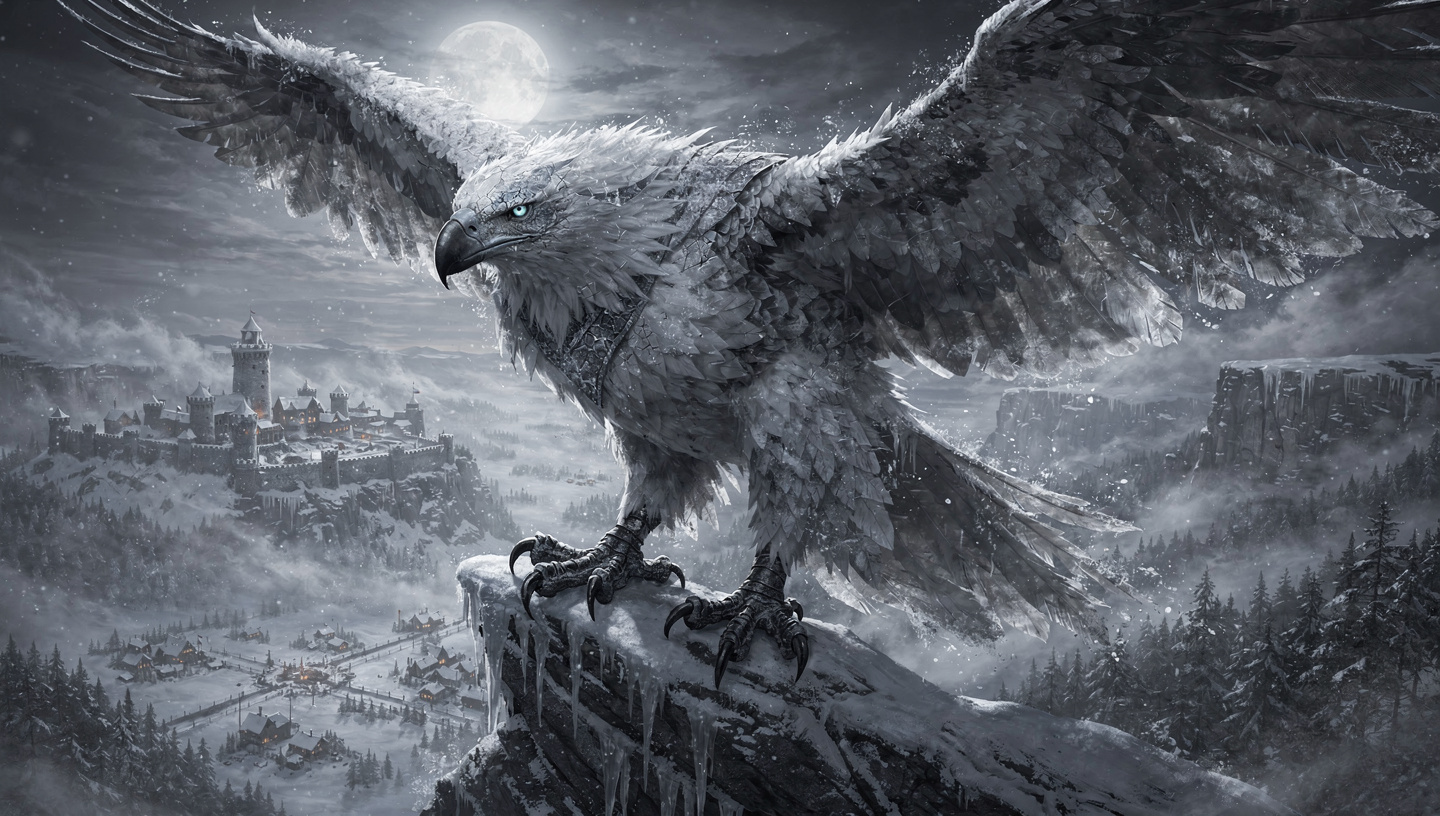
The Great Hræsvelgr (above)
Sacred Beasts
The Vigil draws upon the imagery of two sacred beasts:
The Frost Bear — endurance, force, winter strength, and brutal patience
The Hræsvelgr — a more exalted beast associated with those especially favored by Vetr
The bear, in particular, captures the spirit of the order perfectly. It is not elegant. It is not radiant. It survives. It endures cold, hunger, and hardship, and when roused, it becomes a force of terrifying finality.
Table of Contents
The Priesthood & Cultural Influence
The Iron Spákonas
The spiritual leadership of the Vigil belongs to the Iron Spákonas, seers and religious authorities who interpret what they call the “shiver of the world.” While the Veggdrótt forms the order’s martial arm, the Iron Spákonas give meaning to the signs, silences, tremors, omens, and subtle disturbances that signal movement in the Deep Night.
They serve as spiritual advisors to the Obsidian Throne, ensuring that the rulership of Nottgard is guided not by vanity or ambition, but by attentiveness to unseen threat. This structure reveals much about the order’s priorities. Its priests are not removed from danger; they are interpreters of danger. Their spirituality is not centered on transcendence, but on practical readiness sanctified by ritual and myth.
In this, the Vigil differs sharply from more performative religious traditions. Authority belongs not to the most eloquent or dazzling, but to those capable of correctly reading the world’s tension before it breaks.
Centers of Worship
The two principal sacred spaces of the faith are the Great Bastion of Nottgard and the Altars of the Blue Flame. The Great Bastion is both fortress and temple, a place where military architecture and sacred symbolism are inseparable. The Altars of the Blue Flame are smaller shrines built into mountain hollows, each preserving a single cold-burning fire throughout the year.
These altars beautifully express the theology of Vetr. The flame is not warm abundance or lavish revelation. It is a hard-kept ember in hostile conditions. A fire that persists where it should not persists because someone has chosen to tend it. That, to the Vigil, is holiness.
The Sin of Soul-Freezing
The great taboo of the faith is Neglect of the Hearth. To let a fire die from laziness, or to meet the unknown with cowardice, is considered a Soul-Freezing sin.
This taboo reveals the deeper moral logic of the Vigil. Fire is not merely a domestic utility; it is the fragile mark of human persistence against the cold. To neglect it is to betray the collective duty of survival. Likewise, cowardice is not treated merely as weakness. It is a rupture in the chain of vigilance on which everyone depends.
In a culture formed by real existential threat, negligence becomes a moral crime. The faith therefore produces people for whom discipline is compassion, and readiness is a form of love.
View of Other Faiths
The Vigil regards the Order of the Zenith with thinly veiled contempt, calling them “Day-Blind Children”—southerners who mistake brightness for wisdom and mistake safety for strength. In the eyes of Vetr’s followers, those who revel in the sun do so only because others endure the cold on their behalf.
The Order of the First Ray, by contrast, is tolerated with a kind of restrained respect. The faithful of Aurah are understood as the bridge that announces when one watch has ended and another begins. Even here, however, that respect is practical rather than sentimental. Dawn is welcome because it means the night has held.
This view of other religions demonstrates the order’s place in the spiritual landscape: it does not compete for glamour. It judges all things according to whether they are useful against the dark.
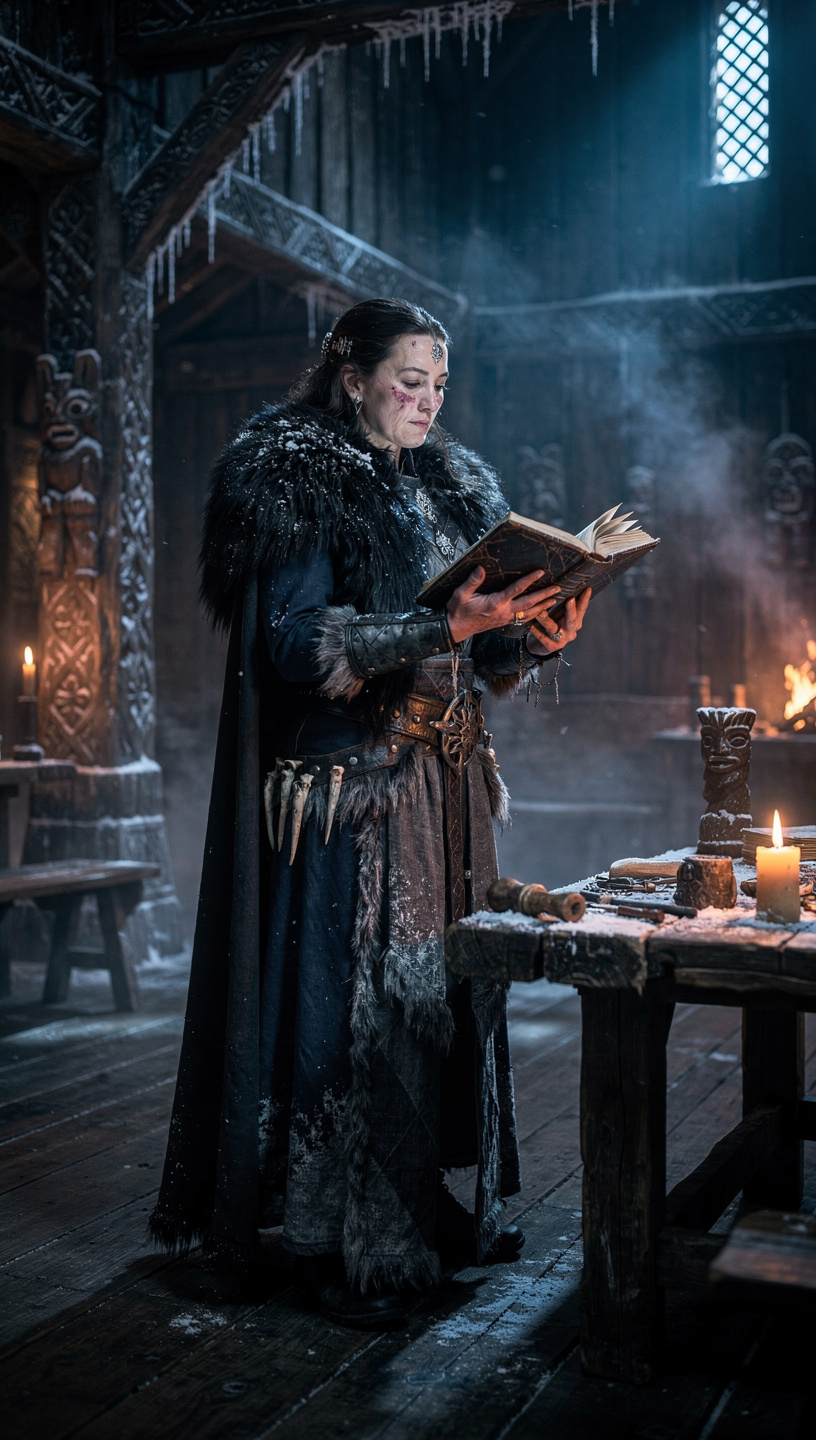
Iron Spákonas Robes (above)
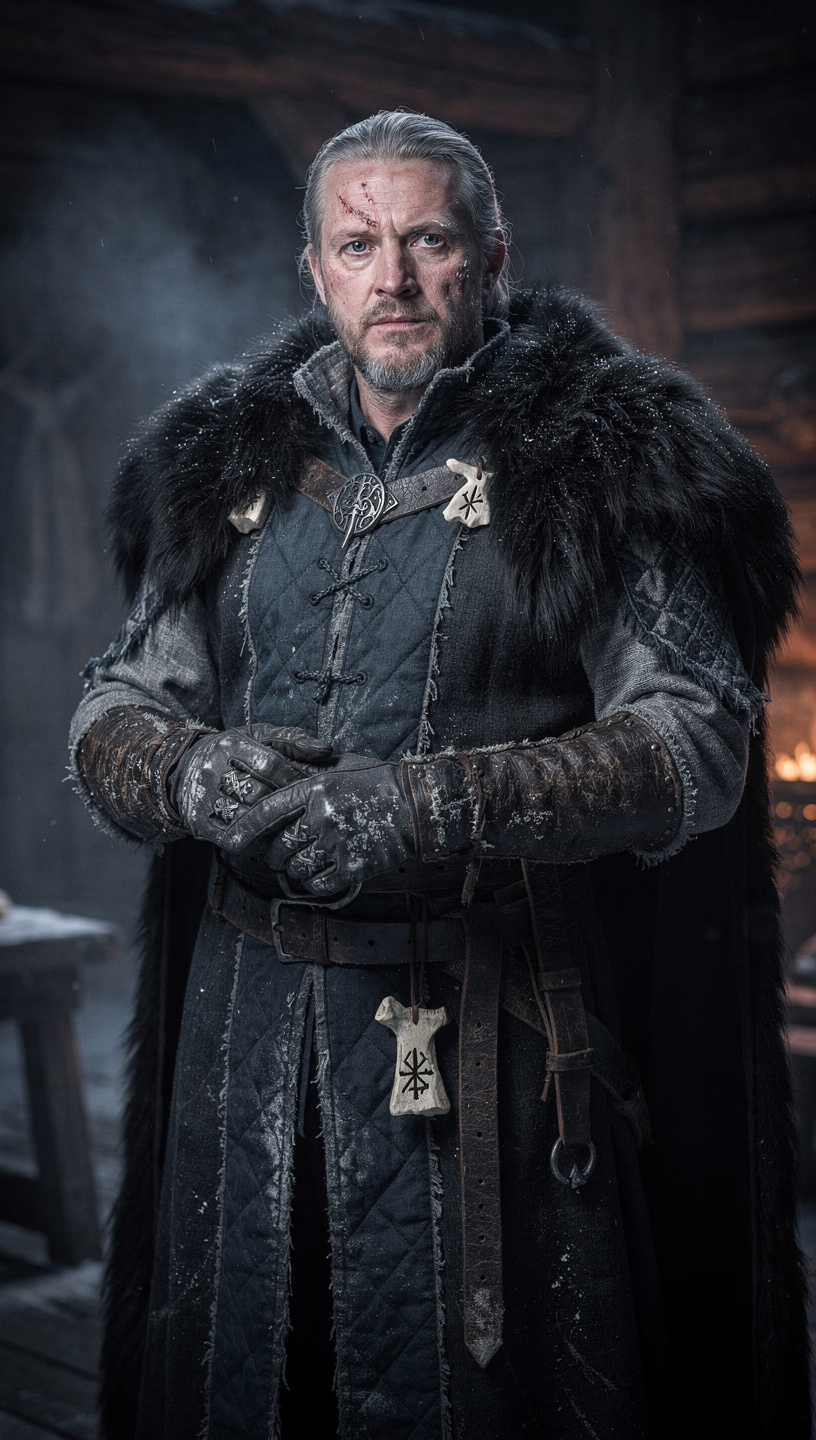
Priest Robes (above)
Table of Contents
Omens & Prophecy
The Frost-Blight
The Vigil interprets the births of 85 AH—elsewhere celebrated or mystified—as The Frost-Blight. To them, these girls are not hopeful signs, but warnings that Vetr’s cloak is fraying and that the Deep Night of Vefna is beginning to seep through its ancient stitches.
This interpretation is deeply characteristic of the faith. Where other traditions see divine gifts, the Vigil first sees breach, instability, and omen. It is the perspective of a people trained to read every anomaly as potential threat. The number, timing, and strange significance of these births are therefore treated not with celebration, but with wary dread.
The Shattered Wall
The gravest prophecy of the faith is the Shattered Wall. It warns that one day the obsidian of Nottgard will turn to brittle glass and break. When that happens, Vetr will fall, and the Night will cease to be a sentinel. It will become a shroud.
The imagery is devastating because it reverses everything the Vigil holds sacred. Obsidian is strength, hardness, threshold, and defense. Glass is fragility, breakage, and failure. The prophecy imagines a world in which what once protected civilization becomes too weak to bear the pressure of the void.
It is not simply an apocalypse of invasion. It is a theological apocalypse—the collapse of the very distinction between Safe Dark and Deep Dark. If that boundary is lost, then the world will no longer have a guardian night. It will have only devouring darkness.
Legacy
The Vigil of the Obsidian Crown endures as one of the harshest and most necessary faiths in the known world. It does not promise beauty, only perseverance. It does not offer comfort, only resolve. Yet within that severity lies a grim nobility: it is the religion of those who accept terror fully and still refuse to move.
To northerners, it may seem cold.
To imperial courtiers, it may seem joyless.
To poets and priests of gentler lands, it may even seem cruel.
But at the edge of the Wall, where silence lengthens and the dark beyond it stirs, no one asks whether a faith is beautiful. They ask whether it holds.
And the Vigil was built to hold.
It is the flame that burns blue in the mountain hollow.
The oath spoken with frost in the lungs.
The hand on the gate when every other hand has fallen away.
For when the light fails, the faithful of Vetr do not pray for rescue.
They stand.
𖤓 NOTICE OF IMPERIAL ACCESS 𖤓
This digital codex is maintained by the Silent Scribes of the Aurionic Lyceum. All records, genealogies, and maps contained herein are the property of the Archive of Ichnusa and are preserved for the eyes of the Imperial Household and authorized scholars. By proceeding, you acknowledge the sanctity of the "Silent Truth." May Sutir guide your quill.
Direct all inquiries to the Office of the Grand Maester.
Copyright © 2026 Brilliance Entertainment. All rights reserved.