The Empire of
The Two Lights

Hazzan Kingdom
“The Sun Never Sleeps”
Overview
The Hazzan Kingdom stands as the blazing heart from which the Aurionic Empire was born—a desert-forged realm of relentless ambition, divine conviction, and unyielding expansion. Defined by its worship of Aurion, Lord of the Light, and its adherence to the doctrines of the Order of the Zenith, Hazzan is a kingdom that believes strength is proven through conquest and legitimacy through dominion.
Its sigil, the Lion, reflects its identity: proud, predatory, and sovereign beneath the ever-watchful sun. From its origins as a collection of fractured city-states, Hazzan rose through blood, strategy, and faith into the dominant force of its age.
Table of Contents
History
The Rise of Malik Hazzan
The foundation of the Hazzan Kingdom begins with Malik Hazzan, born on Maturis 28, 30 BH, a man who would transform rebellion into rulership. At the age of twenty-six, on Zenith 12, 4 BH, Malik overthrew the tyrant of the Marrakesh city-state where his family lived, igniting the first spark of what would become a unified kingdom.
Yet his victory was only the beginning. Over the next four years, Malik consolidated power, organizing the people of Marrakesh and subjugating six neighboring city-states, forging them into a single political entity.
On Solara 1, 0 AH, the Hazzan Kingdom was formally established, marking the beginning of a new era defined by expansion and centralized authority. Malik ruled not merely as a conqueror, but as a unifier, binding disparate peoples under a shared identity rooted in strength and survival.
His reign established the cultural and political foundation of Hazzan—a kingdom that would forever equate power with legitimacy and view fragmentation as weakness. Under Malik, the desert ceased to be a barrier and became instead a crucible, shaping a people hardened by sun, scarcity, and ambition.
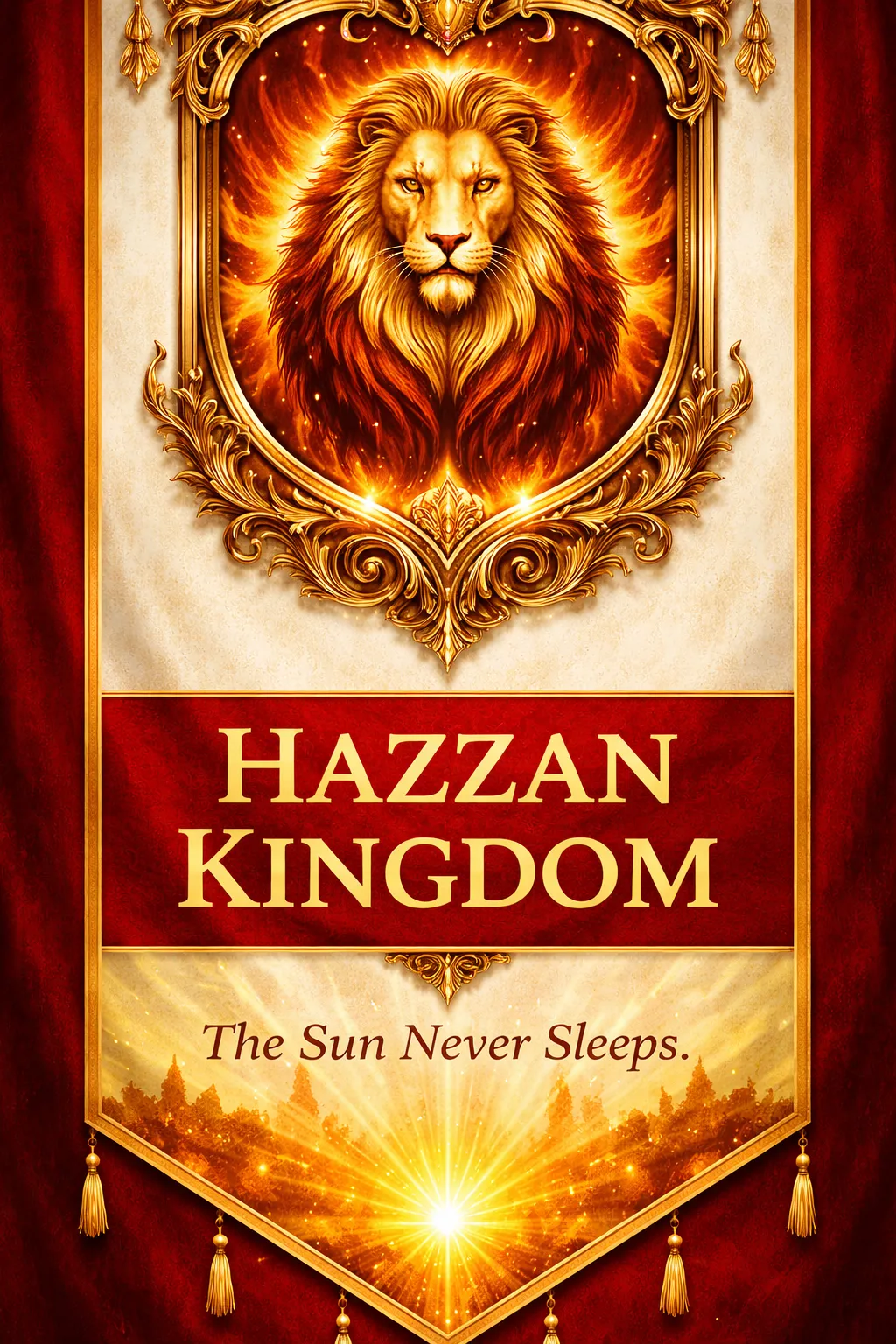
Kingdom Details
Sigil: Lion
Patron Deity: Aurion, the Lord of the Light
Religion: The Order of the Zenith
Colors:
Reds
Yellows
Browns
Whites
Pledged Houses
House Hazzan
House Qibaa
House Zahir
House Malchior
House Qorash
House al-Karim
Current Status: Active
Table of Contents
The Fracture of Blood and the Rise of Kings
Malik’s legacy extended through his children, but it was also the source of future division. His firstborn son, Kadin Hazzan, born on Aestiva 8, 8 AH, was groomed to inherit the throne. Yet Malik’s lineage was not simple. Through his concubine Wafiyah al-Ubari, he fathered Idris al-Ubari, whose destiny would diverge sharply from his brother’s. Through calculated marriages—binding Farida to Kadin and Ayham to Idris—Malik attempted to maintain unity within his bloodline, but the seeds of separation had already taken root.
Upon Malik’s death on Fulmen 20, 40 AH, Kadin ascended to the throne, but his reign was immediately marked by fracture. Just seventeen days later, Idris departed with his wife, seeking to establish his own dominion rather than remain beneath his brother’s rule. This moment would later give rise to the Ubaris Kingdom, marking the first major splintering of Hazzan authority.
Kadin, however, turned inward rather than outward, strengthening his hold over the core territories and redefining the kingdom’s identity through infrastructure and symbolism. His relocation of the capital to Ribat al-Fath—later known as the City of the Two Lights—signaled a shift from conquest alone to imperial vision.
The Wars of the Sun and the Rise of Jalil
The later years of Kadin’s reign were defined by escalating conflict with the Maurim Kingdom, culminating in the First Maurim War on Solara 13, 60 AH, where Kadin met his end in battle. His death, compounded by the absence of Idris—who did not come to his aid—left a kingdom battered but unbroken. His son, Tariq Hazzan, ascended the throne just seven days later, inheriting not peace, but a state of continuous war. It was during this period of unrest that Jalil Hazzan, future emperor, was born on Zenith 8, 61 AH, a child of war destined to end it.
Jalil’s rise marked a turning point not only for Hazzan, but for the world itself. Ascending the throne at eighteen on Primus-Aura 17, 79 AH, he moved with decisive speed—restructuring his court, replacing key figures, and asserting control over a fractured war effort. Within six months, he achieved what generations before him could not: he ended the war with Maurim through conquest on Aestiva 21, 79 AH, and solidified that victory by taking their Crown Princess as his wife.
This act did more than end a conflict—it laid the foundation for something far greater. From the ashes of endless war, Jalil transformed the Hazzan Kingdom into the seed of the Aurionic Empire, proving that the sun of Hazzan did not merely endure—it expanded.
𖤓 NOTICE OF IMPERIAL ACCESS 𖤓
This digital codex is maintained by the Silent Scribes of the Aurionic Lyceum. All records, genealogies, and maps contained herein are the property of the Archive of Ichnusa and are preserved for the eyes of the Imperial Household and authorized scholars. By proceeding, you acknowledge the sanctity of the "Silent Truth." May Sutir guide your quill.
Direct all inquiries to the Office of the Grand Maester.
Copyright © 2026 Brilliance Entertainment. All rights reserved.