The Empire of
The Two Lights

Aurionic Empire
“From the One, All Light.”
Overview
The Aurionic Empire is the most formidable power in the known world, a young but ascendant superstate forged from conquest, diplomacy, sacred doctrine, and dynastic ambition. Born from the Hazzan Kingdom and transformed under the relentless will of Emperor Jalil Hazzan, the Empire presents itself as the divine expression of Aurion’s light—an order meant to gather all worthy lands beneath a single radiant throne.
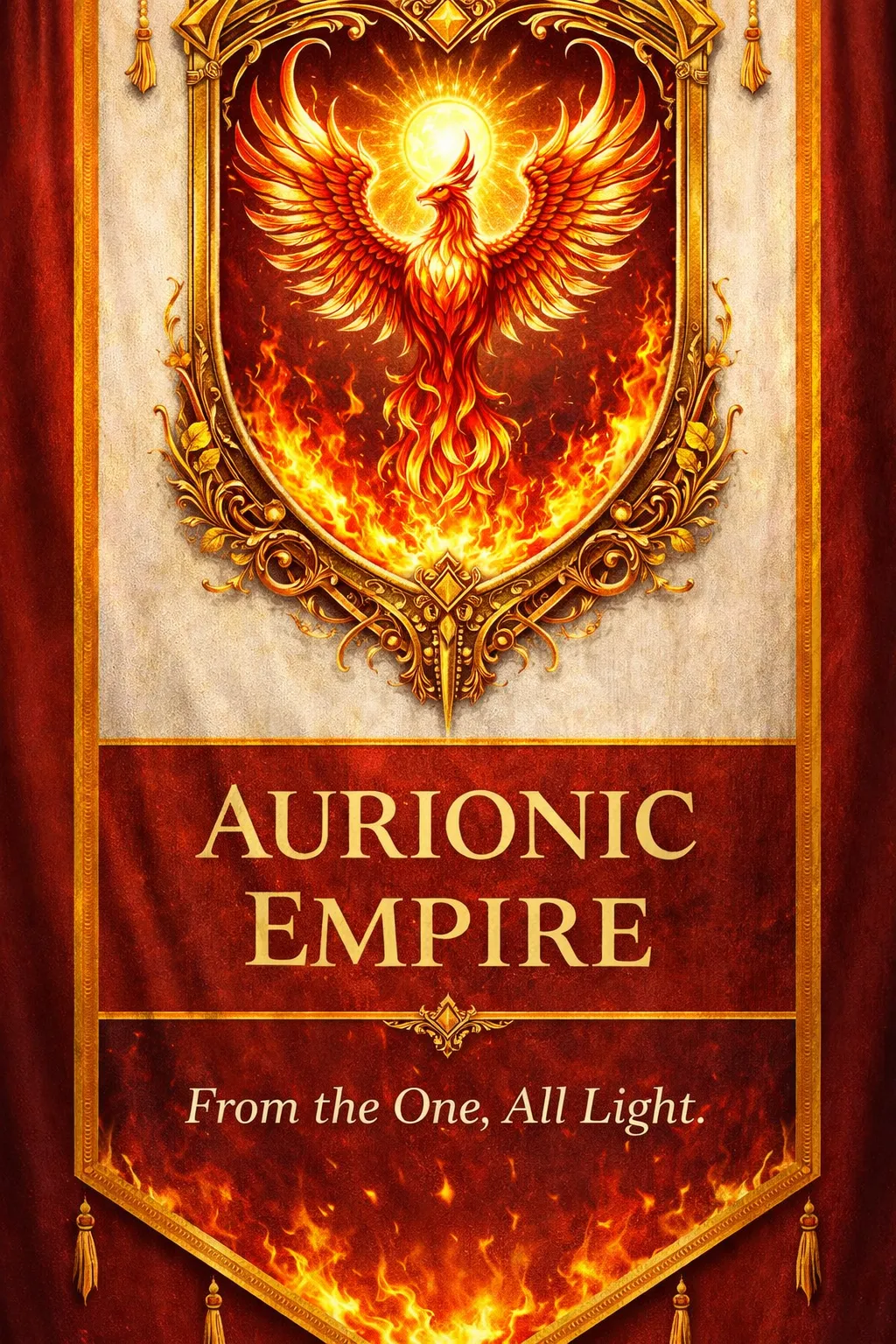
Its sigil, the Phoenix, reflects both its ideology and its image: a realm of fire, rebirth, and unconquerable purpose, where political unity is inseparable from religious destiny. By 96 AH, the Empire spans seven kingdoms and stands at the absolute height of its power, prosperous on the surface and terrifying in its reach.
Table of Contents
History
The Birth of the Empire
The Aurionic Empire began not as an empire, but as the expanding power of the Hazzan Kingdom, whose transformation accelerated when Jalil Hazzan conquered the long-rival Maurim Kingdom on Aestiva 20, 79 AH. From that victory, he took Elena Walid as his second wife after defeating her father, King Hassan Walid, severing her previous betrothal to another Maurim noble house and binding Maurim’s crown directly to his own.
In the months that followed, Hassan Walid was assassinated on Floralis 7, 80 AH, with blame placed upon Elena’s former betrothed household, clearing the last great obstacle to Jalil’s consolidation of Maurim. Then, on Zenith 1, 80 AH, at only nineteen years old, Jalil declared the Aurionic Empire and crowned himself Emperor.
From its earliest days, the Empire was more than a territorial union. It was conceived as a sacred political project, one built upon the worship of Aurion, Lord of the Light, and enforced through the growing influence of the Order of the Zenith, whose doctrine cast imperial rule as divine necessity. The old lion-banner of Hazzan was not discarded, but transformed beneath the imperial Phoenix, a symbol of transcendent rule and sacred renewal.
In this sense, the Empire did not present itself as merely larger than Hazzan—it presented itself as Hazzan’s destined final form, elevated from kingdom to universal mandate.
Kingdom Details
Sigil: Phoenix
Patron Deity: Aurion, the Lord of the Light
Religion: The Order of the Zenith
Colors:
Reds
Yellows
Browns
Whites
Pledged Houses
House Hazzan
House Qibaa
House Walid
House Beauregard
House al-Ubari
House Nottgard
House Villam
House Coill Mór
Current Status: Active
Table of Contents
The Conquests of Legitimacy and Necessity
Jalil’s next great move came on Zenith 14, 82 AH, when he marched upon the Auroreline Kingdom, not simply for land, but for legitimacy. He understood that Auroreline was the cultural jewel of the East—the realm of refinement, elegance, and old prestige—and by subduing it, he could prove the supremacy of the Hazzan “Desert Sun” over the “Sophisticated Dawn.”
He arrived first as a Peace-Bringer, crushing the Nottgard threat on Auroreline’s borders, only to turn his strength upon Auroreline itself. To spare his people annihilation, King Charles surrendered both his crown and his sixteen-year-old daughter, Juliette, to Jalil, giving the Empire not only fertile grainlands, but the prestige of the most admired kingdom in the world.
In 83 AH, Jalil turned west toward Ubaris, where many expected another war between the descendants of divided kin. Instead, he offered his distant second-cousin Haitham a place at his left hand, healing the old rift left by Kadin and Idris and bringing Ubaris into the imperial fold through alliance rather than bloodshed; thus Ubaris became the First Vassal Kingdom.
A year later, on Aestiva 6, 84 AH, Jalil secured Nottgard through stark necessity: his desert-born soldiers could not endure the cold, the Wall was beginning to crack, and only Nottgard’s hard people and devotion to Vetr could hold the South against the wild ones. He offered Alaric terms of vassalage, religious exemption, and a future marriage between Hilde and Grand Prince Aurélien, binding rival bloodlines into one imperial future rather than breaking Nottgard outright.
The Forging of the Seven Kingdoms
Jalil’s expansion continued in Fulmen 1, 85 AH, when he sought the submission of Villamvar, a kingdom that laughed at the thought of desert men surviving their mountain storms and iron warcraft. Knowing that Villamvar respected only strength, Jalil did not send negotiators—he rode to Viharos with only his Sun Guard and challenged Viktoras to the Trial of the Heavens.
In legend, when lightning struck during their duel, Jalil caught the bolt on the Aurionic Blade, redirected its power, and disarmed the storm-king without killing him. Seeing before him not merely a conqueror but a force of nature, Viktoras bent the knee and gave the Empire what it most needed: Thunder-Steel, the forge-strength to arm a world-spanning dominion.
By 86 AH, however, conquest alone could no longer sustain the imperial project, for the realm was suffering from the Great Blight, a mysterious agricultural decay that threatened to starve millions. Jalil realized that he could command armies but not the soil, and so he approached Coill Mór not with war, but with humility, entering the Grove of Aethelgard alone and unarmed.
There he offered Morrigan a Blood-Bond: cultural and religious autonomy, imperial protection, and dynastic union in exchange for healing the Empire’s land and joining the greater structure of his rule. She accepted on Maturis 15, 86 AH, not as a defeated queen, but as one who chose to graft her kingdom onto the imperial tree so it might survive the changing age; and thus, by 96 AH, Jalil ruled a prosperous empire of seven kingdoms, standing at the zenith of power beneath the sign of the Phoenix.
𖤓 NOTICE OF IMPERIAL ACCESS 𖤓
This digital codex is maintained by the Silent Scribes of the Aurionic Lyceum. All records, genealogies, and maps contained herein are the property of the Archive of Ichnusa and are preserved for the eyes of the Imperial Household and authorized scholars. By proceeding, you acknowledge the sanctity of the "Silent Truth." May Sutir guide your quill.
Direct all inquiries to the Office of the Grand Maester.
Copyright © 2026 Brilliance Entertainment. All rights reserved.