The Empire of
The Two Lights

Ubaris Kingdom
“The Eyes See The Truth”
Overview
The Ubaris Kingdom is a land of shifting truths and radiant illusions, where reality itself is treated as something to be interpreted rather than obeyed. Guided by the enigmatic will of Sarab, the Mirage, its people believe that truth is not singular, but refracted—seen differently depending on where one stands.
The falcon, its sigil, represents perception from above: a kingdom that sees what others cannot, even if what it sees is not always what is real. Ubaris thrives on diplomacy, intrigue, and perception, producing some of the most cunning minds in the Empire. Though born from departure, it has become one of the most politically influential realms within the Aurionic order.
Table of Contents
History
The Great Departure and the Founding of Ubaris
The origins of Ubaris lie not in conquest, but in fracture. Following the death of Malik Hazzan on Fulmen 20, 40 AH, the Hazzan Kingdom entered a period of instability that would forever alter its lineage. On Aestiva 18, 40 AH, Idris al-Ubari, driven by ambition and perhaps a deeper calling, departed with his half-sister Ayham Hazzan and one thousand followers into the western lands.
There, beyond the reach of Hazzan authority, he established what would become the Ubaris Kingdom—a realm born from both exile and reinvention.
Idris ruled as a founder-king, shaping a society defined not by rigid law, but by adaptability and vision. Yet his legacy was shadowed by regret. When his brother Kadin Hazzan waged war against the Maurim Kingdom in 60 AH, Idris failed to arrive in time to aid him, a failure that led to Kadin’s death and fractured the Hazzan bloodline.
This moment would haunt Idris until his own death on Floralis 20, 64 AH, leaving behind a kingdom built on ambition, but burdened by guilt.
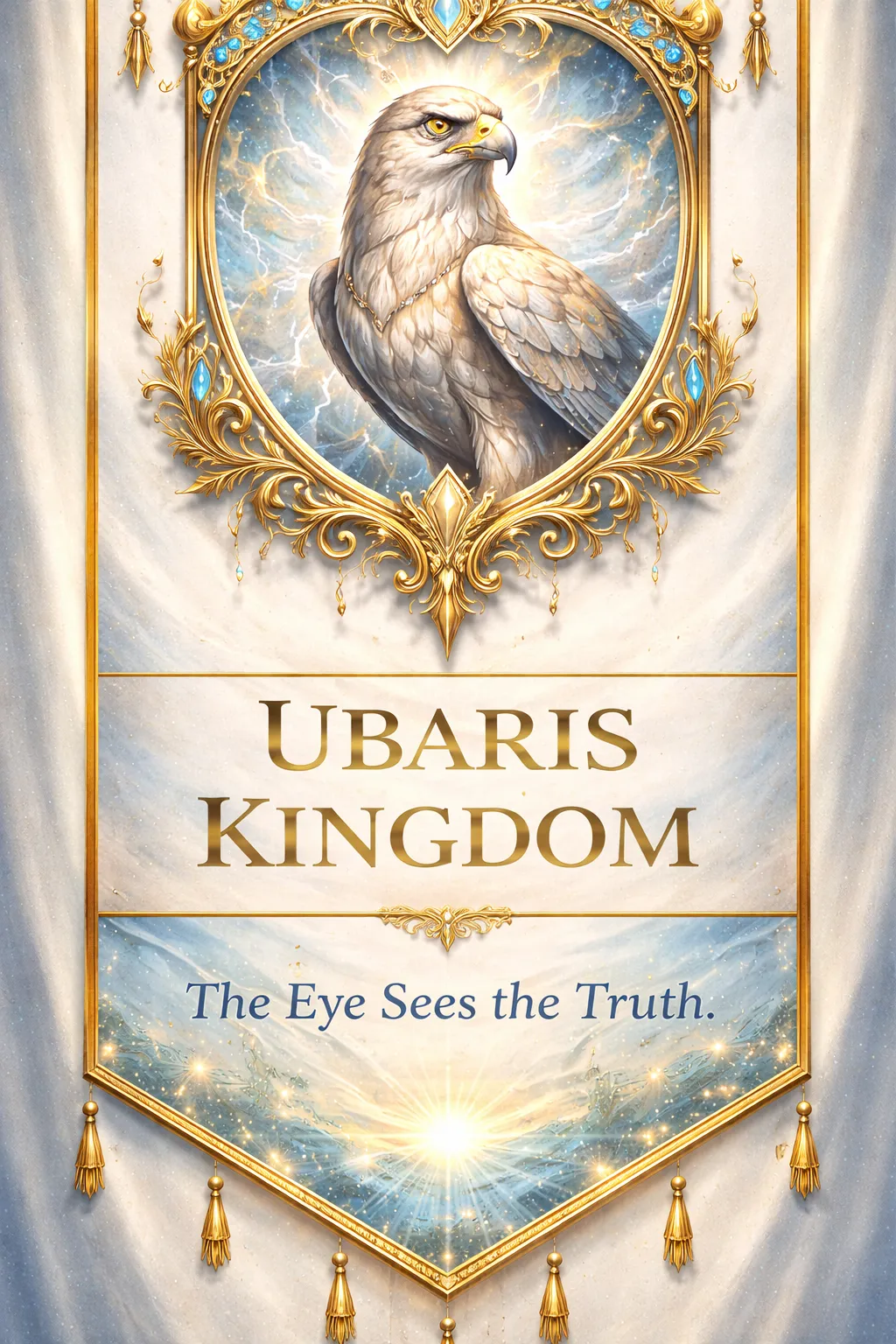
Kingdom Details
Sigil: Falcon
Patron Deity: Sarab, the Mirage
Religion: The Priesthood of the Shifting Veil
Colors:
Iridescent white
Pale gold
Water-blue
Pledged Houses
House al-Ubari
Current Status: Active
Table of Contents
The Age of Excess and the Rise of the Veil
With Idris’ death, his son Samir al-Ubari ascended the throne on Floralis 25, 64 AH, ushering in an era defined less by discipline and more by indulgence. Samir ruled through excess, allowing the court to become a place of decadence, spectacle, and unrestrained desire. This culture of indulgence deeply influenced his son, Haitham al-Ubari, who was granted near-total freedom to roam the kingdom with his caravan, experiencing its people and shaping his worldview through lived experience rather than formal rule.
It was during these travels that Haitham’s destiny began to unfold. In 77 AH, he encountered Samira, a girl raised within the temples, and claimed to receive a vision from Sarab that commanded their union. Their marriage elevated her as the Sun-Queen, symbolizing a bridge to Aurion’s light, while the birth of their son Zayd al-Ubari in 78 AH secured the royal line. Years later, another vision led Haitham to Layla, a mysterious girl of the desert, whom he crowned as the Night-Queen, honoring the balance between light and shadow. Through these unions, Ubaris became a kingdom not of singular truth, but of layered realities—mirroring the doctrine of the Shifting Veil itself.
The First Vassal and the Prism of Power
Upon Samir’s death on Zenith 23, 83 AH, Haitham ascended to the throne shortly thereafter, inheriting a kingdom poised between independence and inevitability. That same year, Jalil Hazzan, now a rising imperial force, arrived in Ubaris not as a conqueror, but as a diplomat. Rather than wage war, Jalil offered Haitham a place at his side—a chance to mend the fracture between their bloodlines and to shape the future of the emerging empire together.
Haitham, recognizing both the brilliance of his cousin and the opportunity before him, accepted.
Thus, Ubaris became the first vassal kingdom of the Aurionic Empire, securing for itself a role unlike any other. Haitham was granted authority as a western regent, ruling in the Emperor’s stead without supplanting the Hand of the Emperor. Through strategic marriages, this alliance was cemented: Prince Zayd al-Ubari was wed to Zakiya Hazzan, while Princess Amira al-Ubari rose as the Golden Prism-Princess, betrothed to Anwar Hazzan.
In this union of blood and power, Ubaris transformed from a kingdom of exile into a cornerstone of imperial strategy—its strength not in armies, but in perception, influence, and the unseen threads that bind empires together.
𖤓 NOTICE OF IMPERIAL ACCESS 𖤓
This digital codex is maintained by the Silent Scribes of the Aurionic Lyceum. All records, genealogies, and maps contained herein are the property of the Archive of Ichnusa and are preserved for the eyes of the Imperial Household and authorized scholars. By proceeding, you acknowledge the sanctity of the "Silent Truth." May Sutir guide your quill.
Direct all inquiries to the Office of the Grand Maester.
Copyright © 2026 Brilliance Entertainment. All rights reserved.