The Empire of
The Two Lights

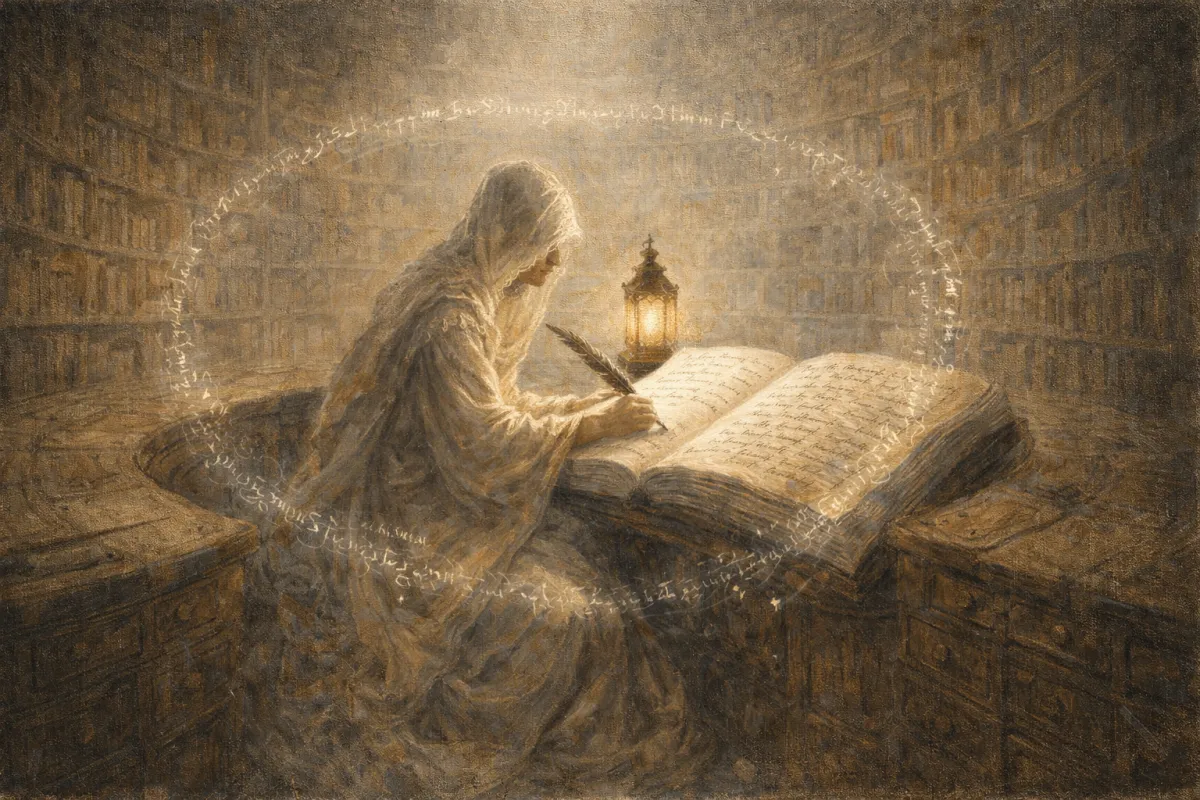
The Maesters of the Midnight Quill
“The Ink Endures when the Light Fails.”
Overview
The Maesters of the Midnight Quill are the custodians of memory—the silent architects of continuity within a world shaped by conquest, faith, and fragile truth. Where kings rule, priests proclaim, and armies carve history into stone and blood, the Maesters ensure that none of it is lost to forgetting.
They are not a religion of spectacle, nor of emotional devotion. Their faith is quiet, methodical, and relentless. It exists in ink-stained fingers, candlelit scriptoria, and the endless halls of the Archive where time itself is bound into scroll and ledger.
To the Maesters, existence is fleeting—but record is permanence. A life unlived may be tragic, but a life unrecorded is something far worse: it is erasure.
If the Order of the Zenith seeks to define truth, then the Maesters of the Midnight Quill seek to preserve it—unaltered, unyielding, and eternal.
Table of Contents
Core Doctrine
Sutir, the Silent Witness
The Maesters revere Sutir, god of Knowledge, Continuity, and Stillness, known as the Silent Witness. He is not a force of action, but of observation—the one who sees, records, and organizes the chaos of existence into something enduring.
To his followers, Sutir does not intervene. He does not judge. He does not command. He documents.
In this theology, the act of recording is sacred. A truth, once written, becomes anchored in reality, resistant to distortion and decay. Without record, even the greatest events dissolve into rumor and myth.
Thus, the Maesters hold a belief both simple and profound:
a fact unrecorded is a soul unborn.
The Pattern in the Stars
The Maesters’ creation myth speaks not of fire or storm, but of structure. When Aurion struck the primordial stone, the spray of starlight that scattered into the far reaches of existence became Sutir.
While other divine forces took form as tangible elements—sun, forest, forge—Sutir became something more abstract: the Pattern within the stars, the first language of the cosmos.
He descended not as a god of presence, but as a shadow trailing behind light, tracing the outlines of all things so they might be remembered after they passed. In this myth, creation is not complete until it is recorded.
Thus, the Maesters believe that existence has two halves:
The moment it occurs
The moment it is written
Only when both are fulfilled does something truly exist in the full sense.
The Law of the Ledger
The central tenet of the Maesters is the Law of the Ledger:
“Existence is a debt; memory is the payment.”
This doctrine defines their role as the accountants of reality. Every action, every life, every decision creates a debt that must be paid through remembrance.
To forget is to default on that debt.
To falsify is to corrupt the entire ledger.
This belief gives the Maesters a unique and often unsettling neutrality. They are bound not to power, loyalty, or emotion—but to accuracy. Truth must be preserved regardless of consequence.
In a world of shifting alliances and competing narratives, the Maesters stand as something rare and dangerous: a record that cannot be negotiated.

The Infinite Quilt (above)
Blessed of Sutir
Zuma, Grand Maester
Davin Solenne, Grand Maester
Leaders of the Maesters
Zuma, Grand Maester
Davin Solenne, Grand Maester
Seats of Worship
Archive of Ichnusa
Aurionic Lyceum
Aurionic Empire
Current Status: Alive
Table of Contents
Rites & Rituals
The Night of the Ink-Wash
The holiest observance of the Maesters is the Night of the Ink-Wash, held on the 4th day of Hiberna, the Silent Month.
On this night, all spoken language is forbidden. Maesters cleanse their quills in silver basins beneath the starlight, honoring Sutir through absolute silence. Communication is conducted only through written tablets, reinforcing the belief that writing is not merely a tool—it is a higher form of expression.
The ritual serves as both purification and reminder:
words spoken fade;
words written endure.
The Oath of the Unbiased Hand
The sacred vow of the Maesters is the Oath of the Unbiased Hand, taken by all who ascend to higher ranks within the order.
This oath binds the Maester to record events exactly as they occur, regardless of personal allegiance or political consequence. Even if the truth would condemn their own House or destabilize the Empire, it must be written.
This makes the Maesters uniquely feared and respected. Their loyalty is not to rulers, but to record itself.
To break this oath is not merely dishonor.
It is a fracture in reality’s continuity.
The Final Page
The funerary rite of the Maesters is known as the Final Page. Upon death, a Maester’s life is distilled into a single master scroll—a precise and elegant account of their existence.
This scroll is sealed within a lead-lined canister and placed in the Deep Vaults of the Archive, ensuring its preservation beyond time. The body is cremated, and the ashes are mixed into Sacred Ink, used by future scribes.
In this way, the Maester continues to write even after death.
Their memory becomes the medium through which new knowledge is recorded.
Table of Contents
Symbols & Sacred Iconography
The Infinite Quilt
The primary symbol of the Maesters is the Infinite Quilt—a vertical scroll bisected by a horizontal line, ending in a single ink-drop.
It represents:
The continuity of recorded history
The intersection of past and present
The permanence of written truth
The ink-drop signifies the moment of inscription—the instant when something transitions from existence into memory.
Vestments of the Page
Maesters wear garments of Off-White, Cream, and Light Beige, reflecting the colors of parchment. Their hands are often permanently stained with ink, a mark not of labor, but of devotion.
Unlike other orders that adorn themselves in symbols of power or divinity, the Maesters present themselves as vessels of record—blank surfaces upon which history may be written.
The Midnight Quill
The most sacred artifact of the order is the Midnight Quill, said to be carved from the feather of a celestial raven. It is believed to never run dry and to write even in complete darkness.
This artifact embodies the Maesters’ ultimate purpose: to ensure that no moment, no matter how hidden or obscured, escapes documentation.

The Ink Owl (above)
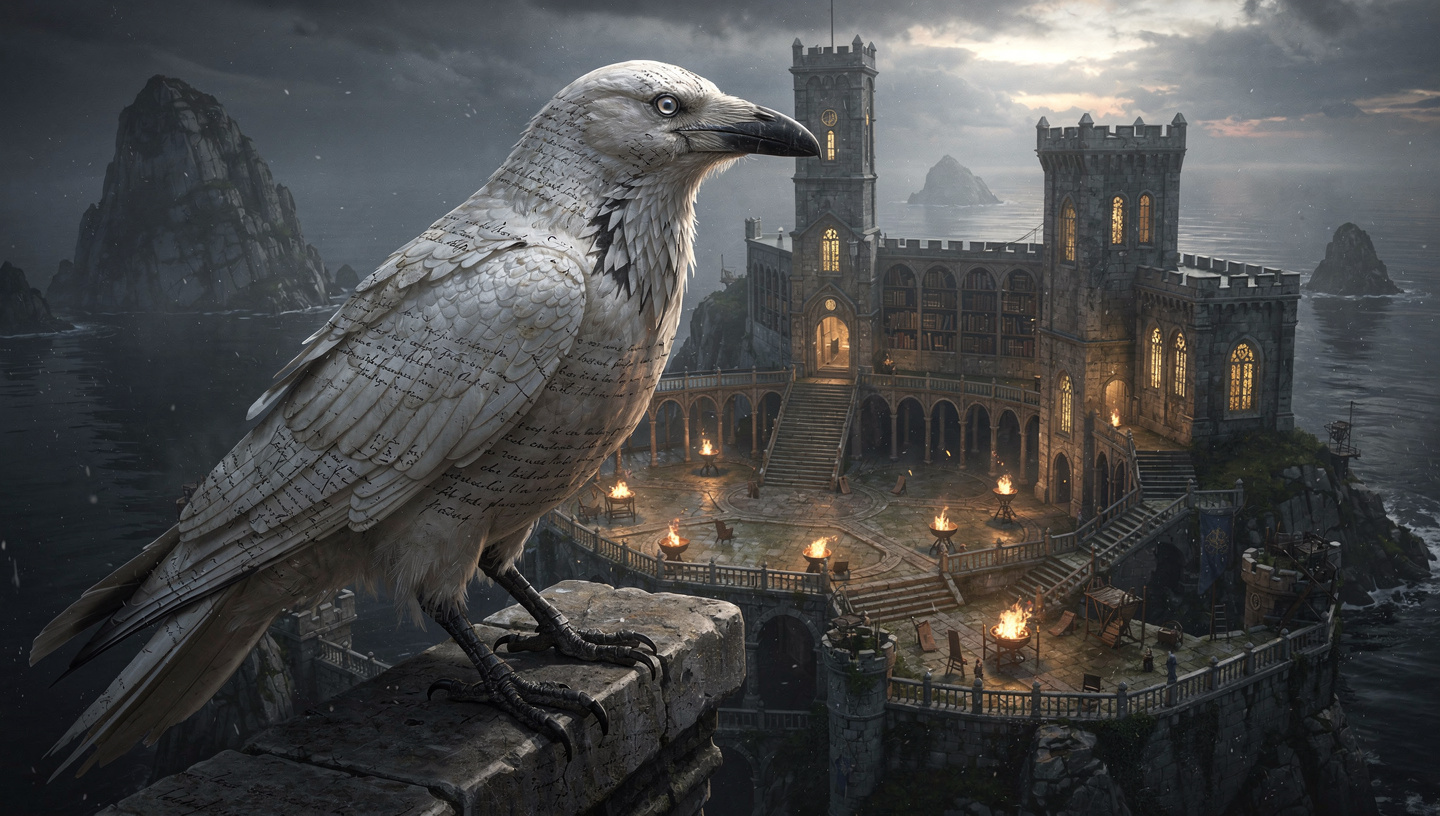
The White Raven (above)
Sacred Beasts
The Maesters claim no sacred animals. This absence is deliberate. Their faith is not tied to nature, strength, or mythic imagery. It is tied to record—a force beyond symbolism.
Table of Contents
The Priesthood & Cultural Influence
The Grand Archive Circle
The Maesters are governed by the Grand Archive Circle, led by the Grand Maester of Ichnusa, whose authority extends across the Aurionic world.
Beneath the Grand Maester stands the Arch-Librarian, keeper of the keys to the forbidden Black Wings—sections of the Archive containing knowledge deemed too dangerous for general access.
This hierarchy reflects the dual nature of the order:
Preservation of all knowledge
Control over how and when it is accessed
Even within a faith dedicated to truth, not all truths are freely given.
Places of Worship
The primary seat of the Maesters is the Archive of Ichnusa, alongside the network of Scriptoriums embedded within castles and administrative centers across the Empire.
These spaces are not temples in the traditional sense. They are repositories—vast, silent, and meticulously ordered. Every scroll, ledger, and record is placed within a system designed to outlast generations.
To enter the Archive is to step into a place where time is no longer fleeting, but contained.
The Revision-Sin
The greatest taboo of the order is the Revision-Sin—the deliberate alteration, destruction, or falsification of recorded history.
This act is considered nothing less than a Murder of the Future, for without accurate record, future generations are deprived of truth.
This taboo underscores the Maesters’ deepest belief:
history is not merely about the past.
It is the foundation upon which all future decisions are built.
View of Other Faiths
The Maesters view the Order of the Zenith as “Loud Proclaimers,” valuing spectacle and authority over precise truth.
They regard the followers of Sarab as “Defilers of Truth,” seeing their illusions and shifting realities as direct threats to the integrity of recorded knowledge.
These perspectives reveal the Maesters’ core tension with the world around them:
truth must remain fixed—even when reality itself does not.

Grand Maester Davin Solenne (above)

Maester Robes (above)
Table of Contents
Omens & Prophecy
The New Chapter
The Maesters interpret the births of 85 AH as The New Chapter—a pivotal turning point in the grand narrative of existence.
Within the Archive, an entire wing is dedicated to tracking these individuals, referred to as the Pleiades. To the Maesters, they are not merely participants in prophecy—they are living entries in a story that began at the moment of creation itself.
This perspective reflects the Maesters’ unique worldview: prophecy is not mystical—it is narrative continuity.
The Blank Page
The most feared prophecy of the order is the Blank Page—a future in which the stars vanish and all ink turns to water.
In this moment:
No record can be made
No memory can be preserved
The story of existence comes to an end
It signifies that Sutir has finished the ledger—and that Vefna is closing the book.
This is not merely the end of the world.
It is the end of meaning itself.
Legacy
The Maesters of the Midnight Quill endure as the quiet backbone of the Aurionic world—a faith that understands that power fades, empires fall, and even gods may be forgotten. But what is written can outlast them all.
To some, they are indispensable.
To others, they are dangerous.
But to those who understand their purpose, they are something far greater:
The memory of the world made permanent.
The voice that speaks when all others are gone.
The hand that ensures nothing is truly lost.
For when the light fades, and the world falls silent—
the ink remains.
𖤓 NOTICE OF IMPERIAL ACCESS 𖤓
This digital codex is maintained by the Silent Scribes of the Aurionic Lyceum. All records, genealogies, and maps contained herein are the property of the Archive of Ichnusa and are preserved for the eyes of the Imperial Household and authorized scholars. By proceeding, you acknowledge the sanctity of the "Silent Truth." May Sutir guide your quill.
Direct all inquiries to the Office of the Grand Maester.
Copyright © 2026 Brilliance Entertainment. All rights reserved.