The Empire of
The Two Lights

Haitham al-Ubari,
King of Ubaris Kingdom
Lord of House al-Ubari • Sultan of the Sands
Overview
Haitham al-Ubari is the sovereign of the Ubaris Kingdom and the first ruler to willingly bind his throne to the Aurionic Empire. As both king and vassal, he occupies a unique position—serving as the Emperor’s governing authority in the western sands while maintaining the independence and identity of his people.
A devout follower of Sarab, the Mirage, Haitham leads not through rigid doctrine, but through fluid understanding—believing that truth, like the desert, is ever shifting.
To his people, he is vision.
To the Empire, he is strategy.
To the desert, he is its chosen son.
Biography
Birth and Lineage
Born on Primus-Aura 23, 63 AH, in the Ubaris Kingdom, Haitham al-Ubari stands as one of the most enigmatic and adaptive rulers within the Aurionic Empire. Bearing titles such as King of Ubaris and Sultan of the Sands, he governs a land defined not by walls or borders—but by shifting dunes, visions, and survival itself.
Where others rule through certainty,
Haitham rules through perception.
Early Life
Haitham was born into a lineage shaped by both kinship and division.
The grandson of Idris al-Ubari and son of Samir al-Ubari, he inherited not only a throne, but the lingering fracture between Ubaris and Hazzan—a divide born from the grief and distance between their ruling houses.
Though he never knew his grandfather, the weight of that separation defined the world he grew into.
In Ubaris, survival was never guaranteed.
It was learned.
The Path of Sarab
From a young age, Haitham’s life was marked by visions—experiences he attributed to Sarab, the Mirage.
At fourteen, he encountered Samira and claimed to receive a divine vision that bound their fates together. He took her as his wife, and through their union, their son Zayd al-Ubari was born the following year.
Years later, another vision led him to Layla, a girl wandering the desert in a state of delirium, speaking of things unseen. He brought her into his kingdom and made her his second wife. Their son, Qasim al-Ubari, was born two years later.
To Haitham, these were not coincidences.
They were guidance.
King of Ubaris
Haitham’s rule reflects the nature of the desert itself—adaptable, unforgiving, and deeply aware.
He is a master of trade and desert warfare, understanding that in a land where resources are scarce and the environment is relentless, power lies in movement, knowledge, and timing.
His kingdom does not rely on rigid structure.
It thrives on flexibility.
The Pact with the Empire
In 83 AH, Haitham faced a decision that would define his reign.
Emperor Jalil Hazzan arrived in Ubaris not as a conqueror, but as an offer. Instead of war, he extended an alliance—one that would place Haitham at his right hand while preserving the autonomy of Ubaris.
Haitham accepted.
Not out of submission,
but out of recognition.
He saw in Jalil not just power, but vision—and an opportunity to heal the divide left by their ancestors.
With this decision, Ubaris became the First Vassal Kingdom of the Aurionic Empire.
The Right Hand of the West
Following the alliance, Haitham assumed a role unlike any other within the Empire.
He governs the western regions in the Emperor’s stead, acting as a sovereign authority within his domain while aligning with imperial objectives. His position does not replace existing structures of power—it complements them.
He is not subordinate.
He is essential.
The Web of Alliance
Haitham secured his kingdom’s place within the Empire through blood as well as diplomacy.
His son, Zayd al-Ubari, was joined in union with Zakiya Hazzan, binding Ubaris directly to the imperial bloodline. Through this alliance, Zakiya became Queen of Ubaris.
His daughter, Amira al-Ubari, was elevated as the first Prism-Princess through her betrothal to Anwar Hazzan, the heir to the emperor's throne, positioning her at the center of imperial succession and identity.
Through these unions, Haitham ensured that Ubaris would not be absorbed into the Empire, but woven into it.
Rule and Philosophy
By 96 AH, Haitham rules as a sharp-eyed and perceptive monarch.
He sees through deception with ease, understanding that the desert teaches one lesson above all others: nothing is ever as it appears.
To some, his kingdom may seem indulgent, even unrestrained.
To Haitham, it is freedom.
He believes that in the desert, survival depends not on rigid morality, but on adaptability and the will to endure.
Personality and Beliefs
Haitham al-Ubari is observant, intuitive, and deeply guided by his faith in Sarab.
He does not impose strict order, nor does he seek to control every aspect of his domain. Instead, he allows his people the space to navigate their own paths—trusting that survival will shape them as it has shaped him.
He values:
Perception above certainty
Freedom above restriction
Adaptability above tradition
Where others seek clarity,
Haitham understands the power of illusion.
Legacy
Haitham al-Ubari represents a different kind of power within the Aurionic Empire:
not conquest, but alignment.
He is the ruler who chose to join rather than be taken—who saw that survival sometimes lies not in resistance, but in transformation.
If others bend to the Empire,
Haitham flows within it—
like the desert wind itself.
Unseen.
Unpredictable.
Unstoppable.
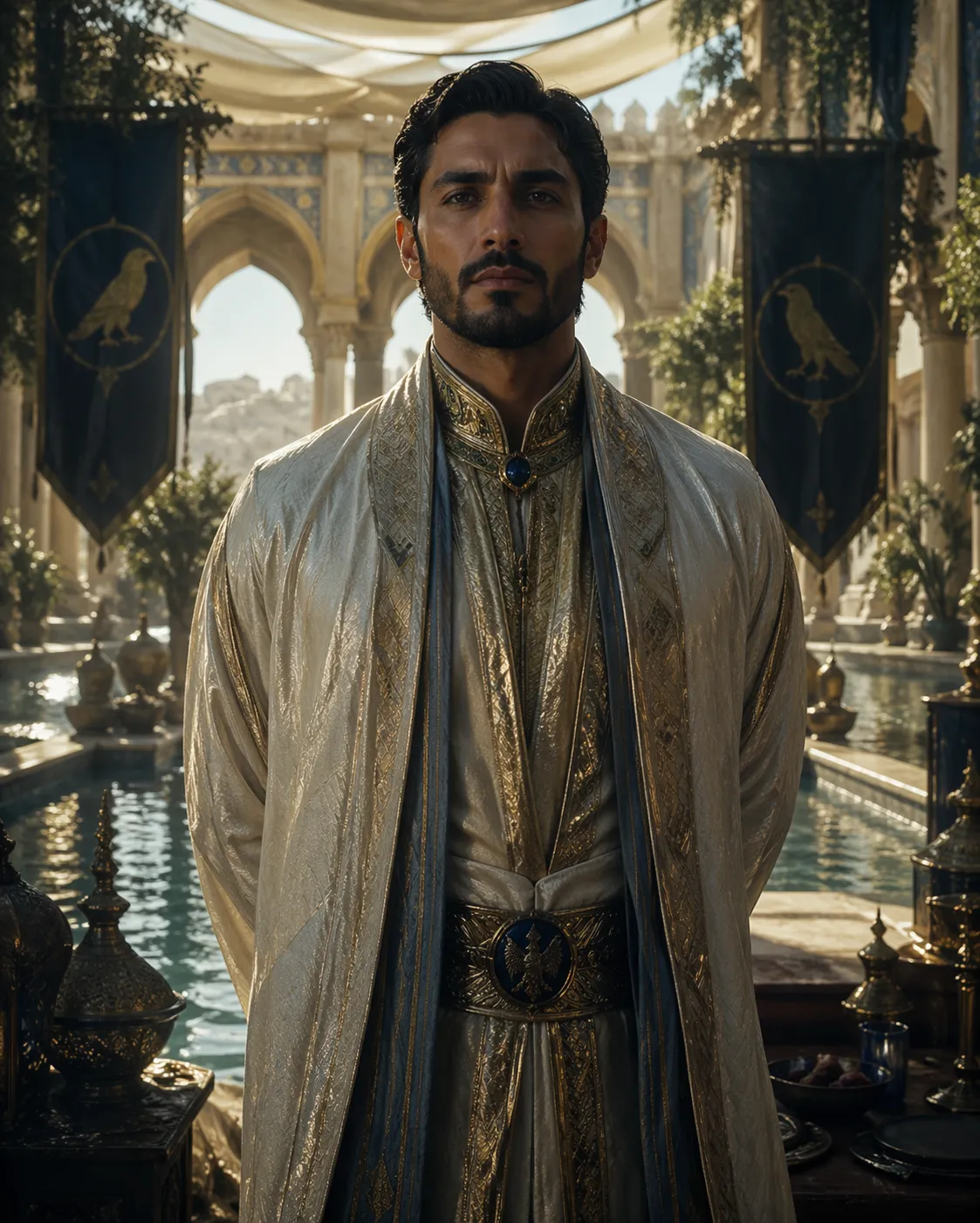
Profile
Biographical Information
Born: Primus-Aura 23, 63 AH in Ubaris Kingdom
Titles
King of Ubaris Kingdom
Lord of House al-Ubari
Sultan of the Sands
Family
Parents: Samir al-Ubari (Father), Jawhara (Mother)
Siblings: None
Children by Samira: Zayd al-Ubari (Son), Amira al-Ubari (Daughter)
Children by Layla: Qasim al-Ubari (Son), Nadira al-Ubari (Daughter)
House / Bloodline: House al-Ubari of Ubaris Kingdom, stewards of Sarab the Mirage; maternal blood of none of the Ubaris Kingdom
Affiliations
Kingdom: Ubaris
Empire Allegiance: Aurionic Empire, Council of the Seven Kingdoms
Religious Alignment: Devoted to the Priesthood of the Shifting Veil; adherent of Sarab, the Mirage
Political Alliances:
Jalil Hazzan, Emperor of the Aurionic Empire
Noor Qibaa, Empress of the Aurionic Empire
Current Status: Alive
𖤓 NOTICE OF IMPERIAL ACCESS 𖤓
This digital codex is maintained by the Silent Scribes of the Aurionic Lyceum. All records, genealogies, and maps contained herein are the property of the Archive of Ichnusa and are preserved for the eyes of the Imperial Household and authorized scholars. By proceeding, you acknowledge the sanctity of the "Silent Truth." May Sutir guide your quill.
Direct all inquiries to the Office of the Grand Maester.
Copyright © 2026 Brilliance Entertainment. All rights reserved.